European Stocks vs US Stocks 2026: Which Route to Use for the Valuation Discount (Direct Shares, ETFs and Tokenized Exposure Compared)
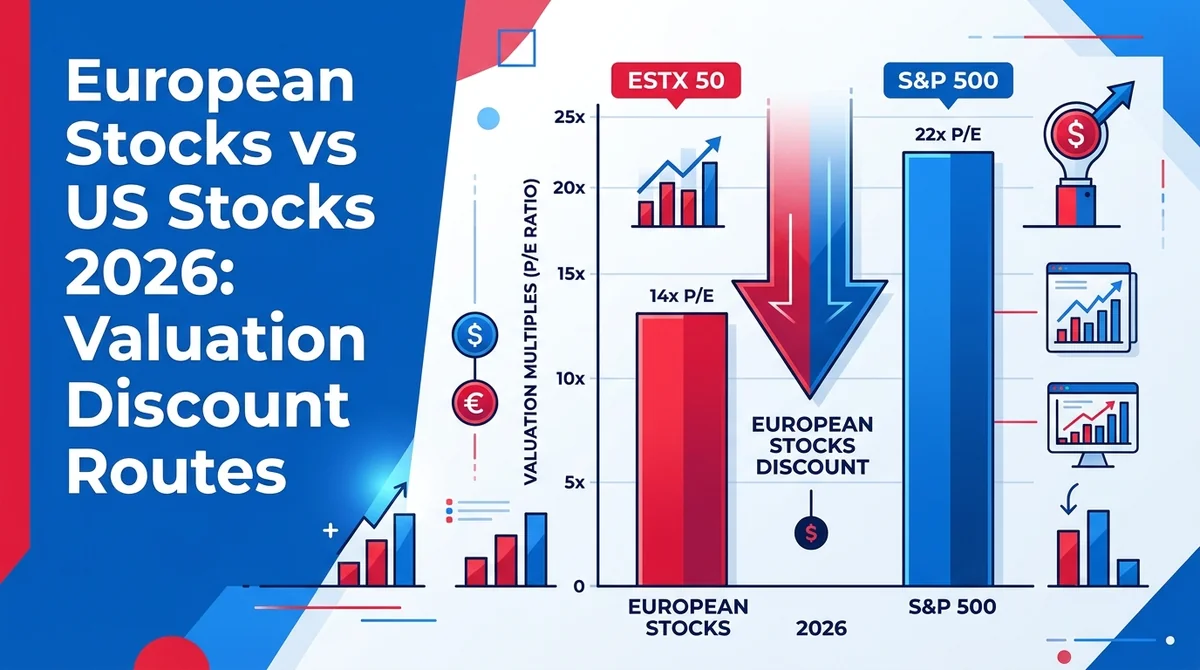
Europe's valuation discount vs US stocks is relative, not a buy signal. Compare direct shares, ETFs and tokenized exposure on cost, FX and risk.
Conclusion: A valuation discount is only a difference in valuation multiples relative to US stocks, not a reason to buy. There are three routes to capture this discount — direct shares, ETFs and tokenized exposure. Choose the route first based on holding period and risk tolerance, then talk about valuation.
#What Exactly Does the European vs US Stock Valuation Discount Mean?
Core judgment: The discount is a relative concept. It measures the gap between overall European market valuation multiples and those of US stocks, not that "European stocks are absolutely cheap." This article does not cite specific valuation multiples or index P/E ratio levels; such data is marked as "data not disclosed."
#The Discount Is Relative to Whom, and Measured How?
The reference point for the discount is US stocks. Common measures include index-level relative metrics such as the P/E ratio, price to book and dividend yield. At any given point in time, the difference in valuation multiples between major European indices and major US indices constitutes the "discount" or "premium." Specific multiples change with the market; this article does not cite unverified figures.
#Why Has the Discount Persisted, and Could It Close?
The discount's persistence is usually linked to three factors: sector structure (European indices carry a higher weight in traditional sectors and a lower weight in tech), differences in expected earnings growth, and differing risk premiums demanded by investors. These are common explanatory frameworks (speculative attribution), not conclusions confirmed by any single empirical study. Whether the discount closes depends on whether these factors reverse; the path and timing are uncertain, and nothing here constitutes a return promise.
#How Does the Discount Relate to FX and Sector Structure?
For non-euro investors, the return on European stocks in local currency roughly equals the change in local share prices plus the change in the exchange rate. Even if the valuation discount narrows, an adverse FX move can offset the gains. Sector structure determines whether the discount reflects "cheapness" or "lower growth expectations" — two very different meanings.
#What Are the Three Exposure Routes to Capture the Valuation Discount?
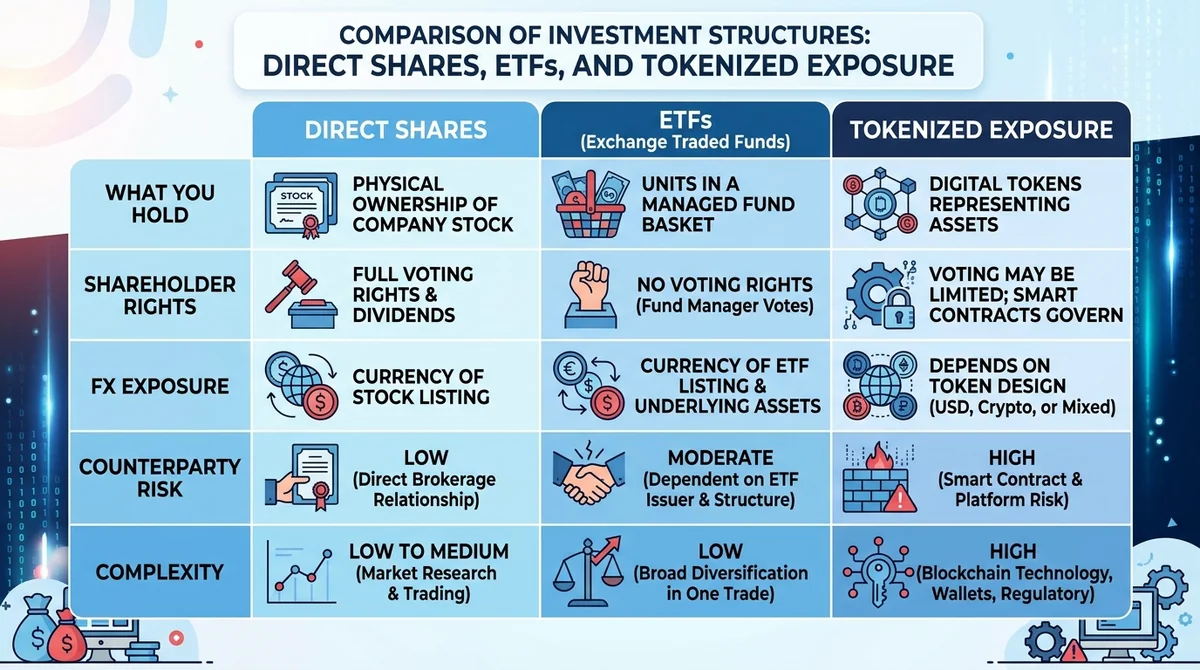
Core judgment: The three routes hold different things — direct shares hold the asset itself, ETFs hold a basket of securities, and tokenized exposure holds only price exposure.
#Direct Shares: What Are You Actually Buying?
Buying shares of European listed companies directly means holding the shares themselves, with the corresponding shareholder rights (such as voting and dividends, subject to local market rules and broker arrangements). The complexity of cross-border account opening, settlement and tax filing is borne by the investor.
#ETFs: How Does Basket Exposure Differ from a Single Stock?
An ETF holds a basket of constituent securities, diversifying single-stock risk but introducing product-level fees and tracking error. An ETF's price is determined by the net asset value of the underlying basket; it is securities exposure, not single-company exposure. Specific fee data is not disclosed and is not fabricated here.
#Tokenized European Stock Exposure: How Many Layers Away from Real Ownership?
Tokenized stocks are price exposure and do not include shareholder status or shareholder rights. Their price is anchored to the real stock price: the real stock price is the cause, the token price is the effect. If a perpetual format is used, it moves closer to a derivative and further from real ownership.
#How Do the Three Routes Compare on Cost, FX and Accessibility?
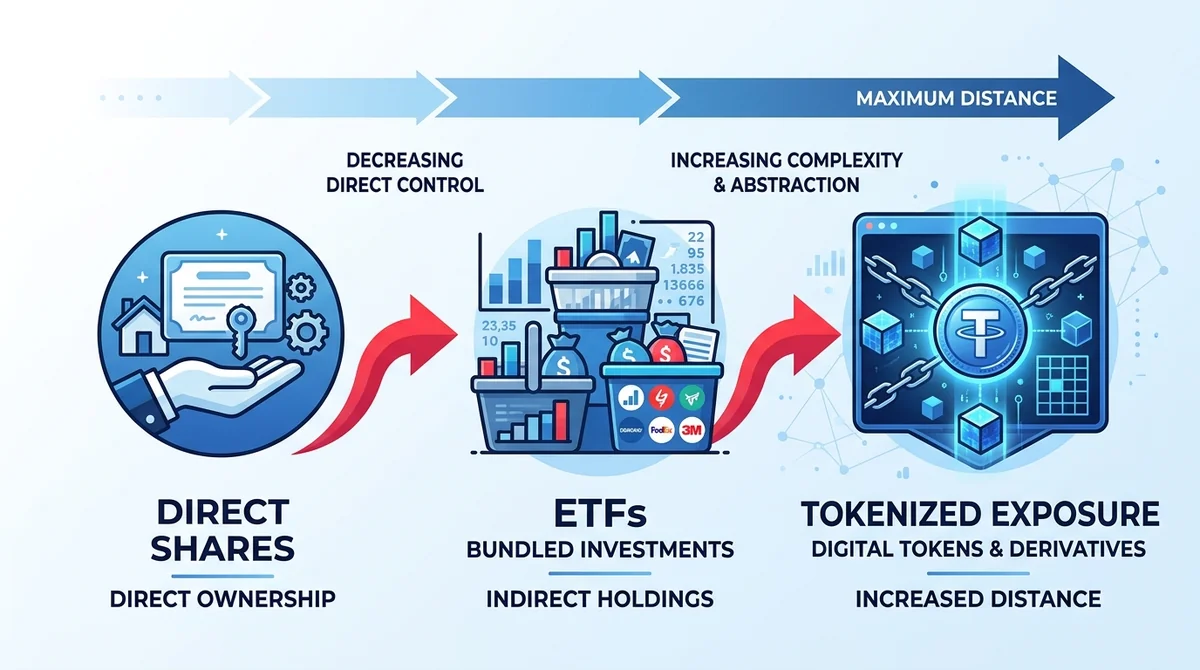
Core judgment: The three routes differ markedly in what is held, cost structure, FX exposure, time-zone settlement and counterparty risk; FX risk does not automatically disappear under any route.
#Where Do Trading and Holding Costs Fall?
Direct shares: costs mainly fall on trading commissions, cross-border settlement and possible custody fee. ETFs: costs mainly fall on product management fees and bid-ask spreads. Tokenized exposure: costs mainly fall on trading fees, funding costs (if leverage or a perpetual format is involved) and on-chain operation costs. Specific fee data for each is not disclosed and should be based on official disclosures.
#How Does FX Risk in Regional Allocation Show Up?
All three routes are exposed to EUR movements against the investor's home currency. Tokenized exposure does not eliminate FX exposure — it merely carries the same price fluctuation in a different vehicle. If the token is denominated in USD, the investor may bear both the underlying currency and the quote currency conversion effects.
#Do Time Zone and Settlement Differences Affect Execution?
Direct shares and ETFs are bound by exchange trading hours and settlement cycles; tokenized exposure can theoretically trade 7×24, but during real-market closed hours, token prices may deviate from the anchor due to thin liquidity. Execution windows and liquidity depth need separate verification.
#Which Route Fits Which Holding Period and Risk Preference?
Core judgment: Long-term allocators able to handle cross-border matters are better suited to direct shares; those seeking diversification and simplicity are better suited to ETFs; tokenized exposure should only be considered for short-term price expression.
#How Should Long-Term Allocators Choose?
If you are a long-term holder able to handle cross-border accounts and tax filing, the direct-share route best matches your needs, because it holds the asset itself.
#How Should Those Wanting Only Short-Term Regional Views Choose?
If you only need to express a short-term view that "Europe will outperform the US" and fully understand the difference between price exposure and shareholder rights, tokenized exposure has its place in operational convenience, but you must also accept counterparty and anchoring-deviation risk.
#How Should Those Unwilling to Bear Cross-Border Complexity Choose?
If you want basket diversification without handling cross-border account opening and settlement, an ETF is the route with the shortest operational chain among the three.
#How Should Those Who Reject Counterparty and Derivative Risk Choose?
If you do not accept counterparty risk, custody risk or derivative structures, you should rule out the tokenized route entirely, including tokenized stock perpetual formats.
#What Extra Risks Come with Tokenized Exposure and Derivative Routes?
Core judgment: Tokenized stocks are only price exposure without shareholder rights; the perpetual format is closer to a derivative and requires bearing additional counterparty, liquidity and anchoring-deviation risk.
#Why Aren't Tokenized Stocks Real Ownership?
Tokenized stock prices track the real stock, but whether holders enter the shareholder register and enjoy rights such as voting and dividend distribution depends on the issuer's structure and rules and must be verified item by item — it cannot be generalized. How corporate actions (splits, dividends, mergers) are handled likewise depends on issuer rules.
#How Far Is Perpetual Exposure from Real Stocks?
Tokenized stock perpetuals are derivative structures, typically using mechanisms such as how does perpetual futures funding rate work to keep prices close to the underlying, and may include perpetual futures leverage and forced liquidation — the biggest mechanical difference from holding real stocks. Specific parameters should be based on platform disclosures.
#How Should Counterparty and Liquidity Risk Be Assessed?
Three items need verification: the credit and reserve disclosures of the issuer or custodian, secondary market depth and bid-ask spreads, and the history of token price deviation from the underlying. If any of the three is missing, it should be treated as insufficiently disclosed risk.
#Action Checklist
- Clarify whether you want to "hold the asset" or "express a price view" — this step determines the route.
- Verify the target market's trading hours, settlement cycle and tax treatment rules.
- Verify the ETF's tracking index, constituent composition and fee disclosures (record as pending verification if data is not disclosed).
- If considering tokenized exposure, verify the issuer's reserve disclosures, anchoring-deviation history and liquidity depth.
- Calculate FX exposure: confirm whether the quote currency and the underlying currency match.
- Confirm whether you can bear counterparty risk and derivative structure risk.
- Record the data cutoff date and review periodically thereafter.
#FAQ
Q: Does a narrowing valuation discount mean European stocks will outperform US stocks? A: No. A narrowing discount only means the valuation multiple gap is shrinking; index returns are also affected by earnings changes and FX, so the two cannot be equated.
Q: Can tokenized European stock exposure replace direct shareholding? A: Not entirely. Tokenized exposure is price exposure and usually excludes shareholder rights; the two differ in rights and mechanics.
Q: Do ETFs eliminate FX risk? A: No. An ETF is only a vehicle; if the underlying assets are denominated in EUR while the investor measures in another currency, FX exposure remains.
Q: Which of the three routes has the lowest cost? A: It depends on holding period, trading frequency and specific product terms. Fee data is not disclosed, so no uniform conclusion can be given; each item must be calculated from official disclosures.
Q: What is the difference between tokenized stock perpetuals and tokenized stock spot? A: The former is a derivative structure, typically including how does perpetual futures funding rate work and forced liquidation; the latter is a price-exposure vehicle. Neither usually includes shareholder rights, but their risk levels differ.
This content is compiled from public information and does not constitute investment or open account advice. Actual conditions may change; please refer to the official disclosures of the relevant platforms for specific terms.
FAQ
Does a narrowing valuation discount mean European stocks will outperform US stocks?
No. A narrowing discount only means the valuation multiple gap is shrinking; index returns are also affected by earnings changes and FX, so the two cannot be equated.
Can tokenized European stock exposure replace direct shareholding?
Not entirely. Tokenized exposure is price exposure and usually excludes shareholder rights; the two differ in rights and mechanics.
Do ETFs eliminate FX risk?
No. An ETF is only a vehicle; if the underlying assets are denominated in EUR while the investor measures in another currency, FX exposure remains.
Which of the three routes has the lowest cost?
It depends on holding period, trading frequency and specific product terms. Fee data is not disclosed, so no uniform conclusion can be given; each item must be calculated from official disclosures.
What is the difference between tokenized stock perpetuals and tokenized stock spot?
The former is a derivative structure, typically including how does perpetual futures funding rate work and forced liquidation; the latter is a price-exposure vehicle. Neither usually includes shareholder rights, but their risk levels differ.
Related Terms
Done comparing? Ready to place your first trade?
The crypto assets, tokenized US stocks and ETFs you just compared are all tradable on MSX — spot or perpetuals.
Quick Start Trading →New here? Registration takes three quick steps.