Beyond the NVDA Spread Comparison: Measured Spread Widening in Tokenized Nvidia Stock During US Pre-Market and After-Hours Sessions in 2026
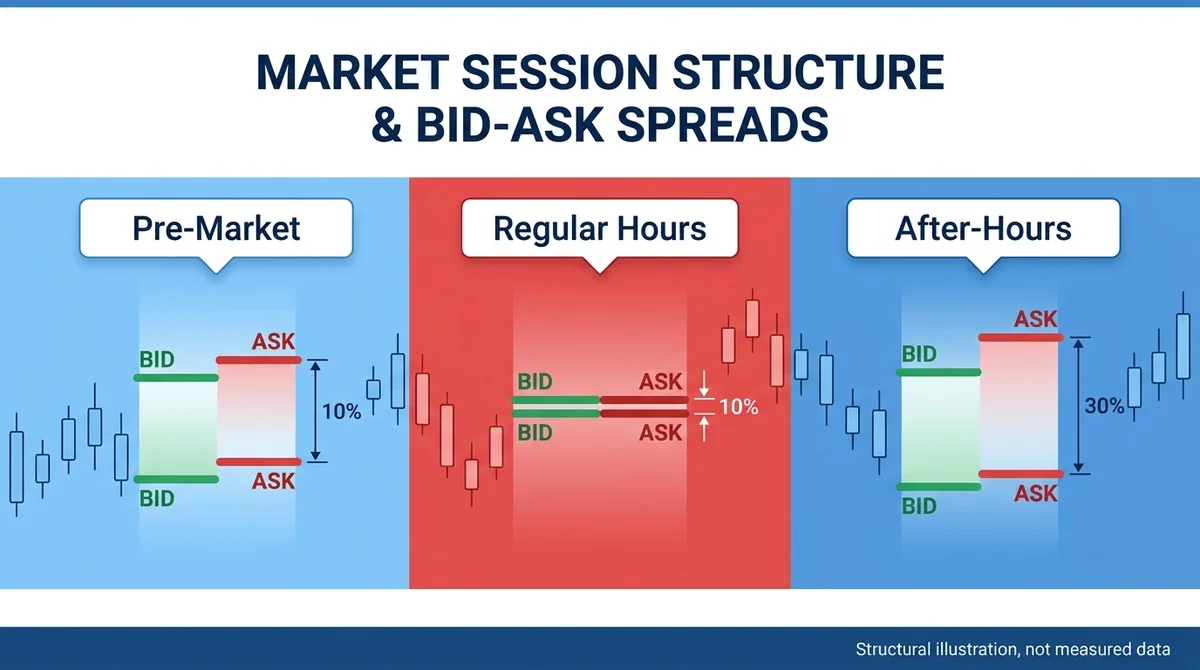
A session-by-session breakdown of tokenized Nvidia stock spreads and slippage across pre-market, regular, and after-hours trading, plus why spreads widen and when to order.
Conclusion: The spread on tokenized Nvidia (NVDA) should not be judged by a single all-day average. Pre-market and after-hours sessions are US extended hours, where underlying quote depth is thinner than in regular trading hours, so quotes on the token side tend to widen more easily. To judge execution cost, you must look at pre-market, regular, and after-hours sessions separately. If cost comes first, regular trading hours are the default choice; if you must trade during thin-liquidity sessions, use limit orders and split large orders. This article is a structural comparison and methodology note; it does not provide third-party-verified measured spread values by session.
#Why should tokenized NVDA stock spreads be viewed separately during pre-market and after-hours?
#Where do tokenized stock prices come from?
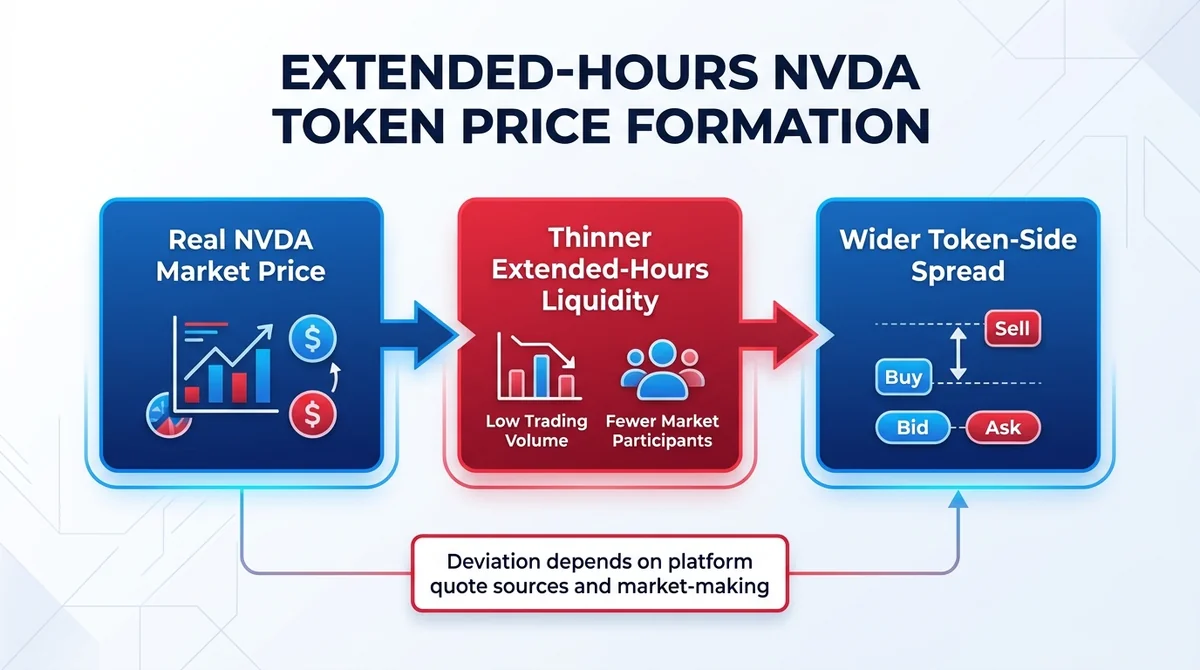
A tokenized stock is not real US equity ownership; it provides a price exposure. Its quote is anchored to the real NVDA market price: the real US stock price is the cause, and the token price is the effect. So discussing spreads on the token side is essentially discussing how the quote quality of the underlying real market in that session transmits to the token side.
Note that tracking deviation may exist between token-side quotes and actual underlying market quotes. The size of that deviation depends on the platform's quote sources, settlement mechanism, and market-making arrangements. This article makes no unverified assertions about the specific magnitude of that deviation.
#Why do spreads tend to widen more easily during pre-market and after-hours sessions?
US pre-market and after-hours sessions are extended hours, where the market makers quoting and the matching depth are usually weaker than in regular trading hours. As underlying market liquidity thins, the gap between bid and ask quotes often widens accordingly, and token-side quotes may also widen. This is a common structural phenomenon, but the degree of widening varies by platform, instrument, and that day's news flow, and cannot be generalized.
Key points: Tokenized stocks ≠ real US stocks; they are a price exposure. US stock prices are the cause, token prices are the effect. Pre-market and after-hours liquidity is usually thinner, so quotes more easily widen.
#How do spreads differ across pre-market, regular, and after-hours sessions?
#How much do spreads usually differ between regular trading hours and pre-market/after-hours?
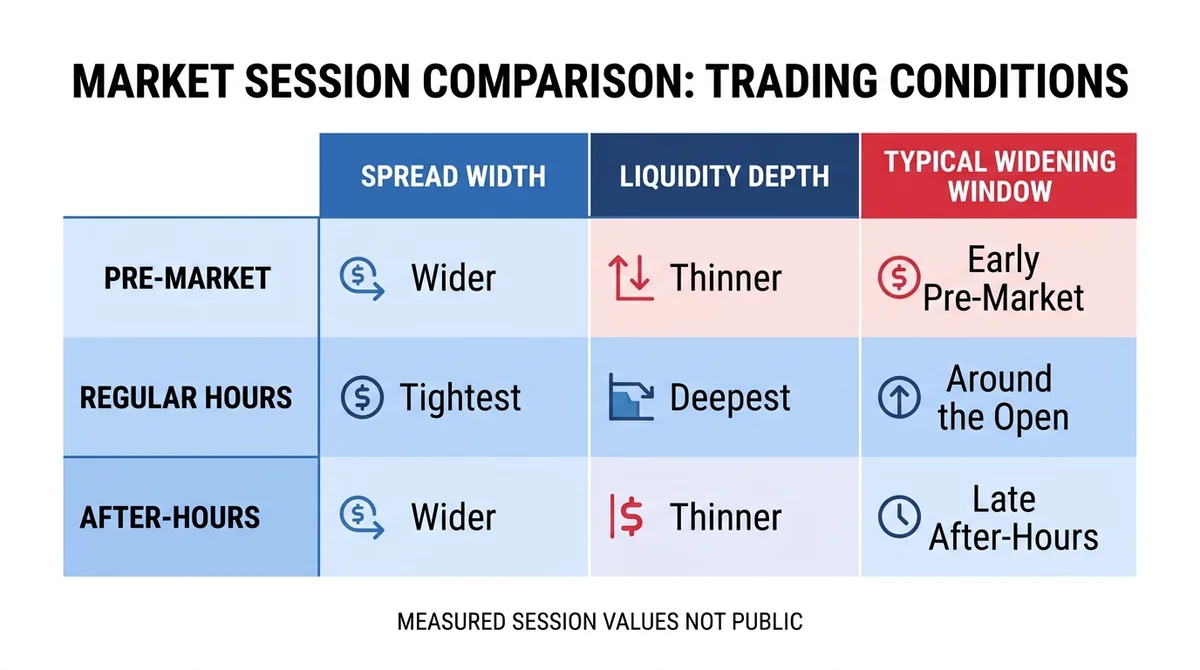
Directionally, it is reasonable to infer that spreads in regular trading hours are usually the tightest and wider in pre-market and after-hours. But the specific multiple and absolute values depend on the platform's quote sources, the instrument's activity, and that day's news flow. This article does not provide unverified figures; the relevant session-by-session measured data is not public, and readers should rely on continuous sampling on their own platform for the same instrument and the same session.
#Is spread widening persistent, or does it only appear around the open?
From a session structure perspective, widening is more likely concentrated in the windows with the thinnest liquidity and the densest information: the early pre-market, around the regular open, and the late after-hours. Occasional price jumps can still occur in the relatively stable stretches in between, so judgments cannot rely on a single snapshot; multi-day continuous sampling is needed to distinguish structural differences from same-day noise.
Key points: Session layers are pre-market / regular / after-hours. Widening is more likely concentrated in the thinnest-liquidity windows. Where specific figures are missing, the data is marked as not public.
#How does spread widening affect actual execution cost and slippage?
#Are spread and slippage the same thing?
No. The spread is the difference between bid and ask quotes; it is a visible quote cost that can be read before ordering. Slippage is the deviation between the actual execution price and the expected price; it is only confirmed after execution and depends on order book depth and order type at that time. Spread widening raises the cost baseline, while slippage determines how much final deviation there is.
#Why are large orders more likely to suffer during thin-liquidity sessions?
During thin-liquidity sessions there are fewer resting orders, so a single large market order may sweep through multiple price levels in succession, pushing the average execution price away from the best bid or best ask. Market orders prioritize execution certainty, while limit orders prioritize price certainty at the cost of possibly not filling. The larger the amount, the more significant this difference usually is.
Key points: Spread is quote cost; slippage is execution deviation. Depth is insufficient in thin-liquidity sessions. Market and limit orders involve different trade-offs.
#How should a session-by-session spread test be designed and recorded?
#How should sampling frequency and session segmentation be set?
Fix the same instrument (tokenized NVDA stock) and fix the session definitions (pre-market / regular / after-hours each counted independently), and sample continuously at fixed intervals within each session, avoiding taking only the extremes at the opening instant or closing instant. Repeating across multiple days is necessary to distinguish structural differences from same-day noise.
#Which fields need to be recorded for comparison?
At minimum, record: timestamp, session label, best bid, best ask, absolute and percentage spread, visible order book depth, and the assumed order type for that sample (market / limit). Without these fields, spread numbers cannot be compared across the board.
Key points: Same instrument, same session definitions. Record best bid and ask, spread, and order book depth. Distinguish order types.
#To reduce the impact of spread widening, how should you choose order timing and order type?
#When should you avoid pre-market and after-hours?
If you are a cost-sensitive user, concentrate executions in regular trading hours and accept the trade-off of not being able to react the instant news breaks.
If you must react to pre-market or after-hours news, accept wider quotes and set your maximum acceptable spread in advance as a hard condition.
#Can limit orders solve the slippage problem?
Limit orders can lock in the worst execution price but cannot guarantee a fill. If the single order amount is large, split the order and place limit orders in batches to reduce single-order impact. If certainty of execution matters more, accept the deviation that market orders may bring during thin-liquidity sessions.
Key points: If liquidity comes first, choose regular trading hours. If you must trade in thin liquidity, use limit orders. If the single order amount is large, split the order.
#Risks and disclaimers for session-based tokenized stock trading
Tokenized stocks provide a price exposure; they do not constitute shareholder status in Nvidia and do not carry shareholder rights such as voting rights. The way corporate actions and dividends are passed through differs from direct shareholding (see the on-site comparison of differences in corporate actions between direct shareholding and tokenized stocks). Pre-market and after-hours thin-liquidity sessions see greater volatility and higher slippage risk, and quote sources may also briefly deviate. This article is for structural comparison and methodology explanation only and does not constitute investment advice.
This content is compiled from public information and structural reasoning and does not constitute investment or open account advice. Where specific figures are not stated, it is because verifiable sources are lacking, and actual conditions may change.
To check a platform's quote and fee conventions, refer to that platform's official sources and announcements.
FAQ
Why are tokenized Nvidia spreads wider during pre-market and after-hours?
Because the token price is anchored to the real US stock, and US pre-market and after-hours are extended sessions where the market makers quoting and the matching depth are usually weaker than in regular trading hours. Thinner underlying liquidity may transmit into wider bid-ask quotes on the token side. The specific degree of widening varies by platform and that day's news flow; this article does not provide verified measured values.
Are spread and slippage the same thing?
No. The spread is the difference between the best bid and best ask; it is a quote cost visible before ordering. Slippage is the deviation between the actual average execution price and the expected price; it depends on order book depth and order type and is only confirmed after execution.
How much exactly do spreads differ between pre-market/after-hours and regular sessions?
Directionally, regular sessions are usually the tightest and pre-market/after-hours are wider, but the specific multiple depends on the platform's quote sources, the instrument's activity, and that day's news flow. This article does not provide unverified figures; the relevant session-by-session measured data is not public, and we recommend continuous sampling yourself under the same instrument and the same session definitions.
Can limit orders completely avoid slippage during thin-liquidity sessions?
Limit orders can lock in the worst execution price, so there will be no adverse price slippage, but the trade-off is that they may not fill. For large orders, we recommend splitting and placing limit orders in batches to reduce single-order impact.
Is a tokenized stock the same as directly holding Nvidia shares?
No. A tokenized stock provides a price exposure; it does not constitute shareholder status and does not carry shareholder rights such as voting rights. The way corporate actions and dividends are passed through also differs from direct shareholding.
Related Terms
Done comparing? Ready to place your first trade?
The crypto assets, tokenized US stocks and ETFs you just compared are all tradable on MSX — spot or perpetuals.
Quick Start Trading →New here? Registration takes three quick steps.