NVDA vs AMD AI: 2026 Architecture, Software, and TCO Comparison
Compare NVDA vs AMD AI architectures, CUDA vs ROCm software moats, and deployment TCO to evaluate enterprise hardware exposure for your 2026 portfolio.
#NVDA vs AMD AI: 2026 Architecture, Software, and TCO Comparison
NVIDIA (NVDA) dominates the enterprise artificial intelligence landscape through its integrated proprietary ecosystem powered by CUDA and high-bandwidth NVLink networking. Advanced Micro Devices (AMD) challenges this stronghold with competitive memory capacity in its Instinct accelerators and an open-source ROCm platform, offering enterprises a cost-effective alternative to reduce single-vendor lock-in across data center deployments.
#Key Takeaways
- Architecture Focus: NVIDIA prioritizes vertically integrated hardware-software fabrics, while AMD emphasizes higher memory density per accelerator package.
- Software Moat: CUDA maintains a decade-long developer network effect; AMD's ROCm is rapidly narrowing the integration gap across mainstream frameworks like PyTorch.
- Total Cost of Ownership (TCO): AMD provides aggressive compute-per-dollar ratios and hardware availability, balancing NVIDIA's premium acquisition pricing and software maturity.
- Exposure Strategy: Allocating capital between NVDA and AMD balances market leadership and margin defense against challenger growth upside.
#How Do NVIDIA and AMD AI Chip Architectures Compare?
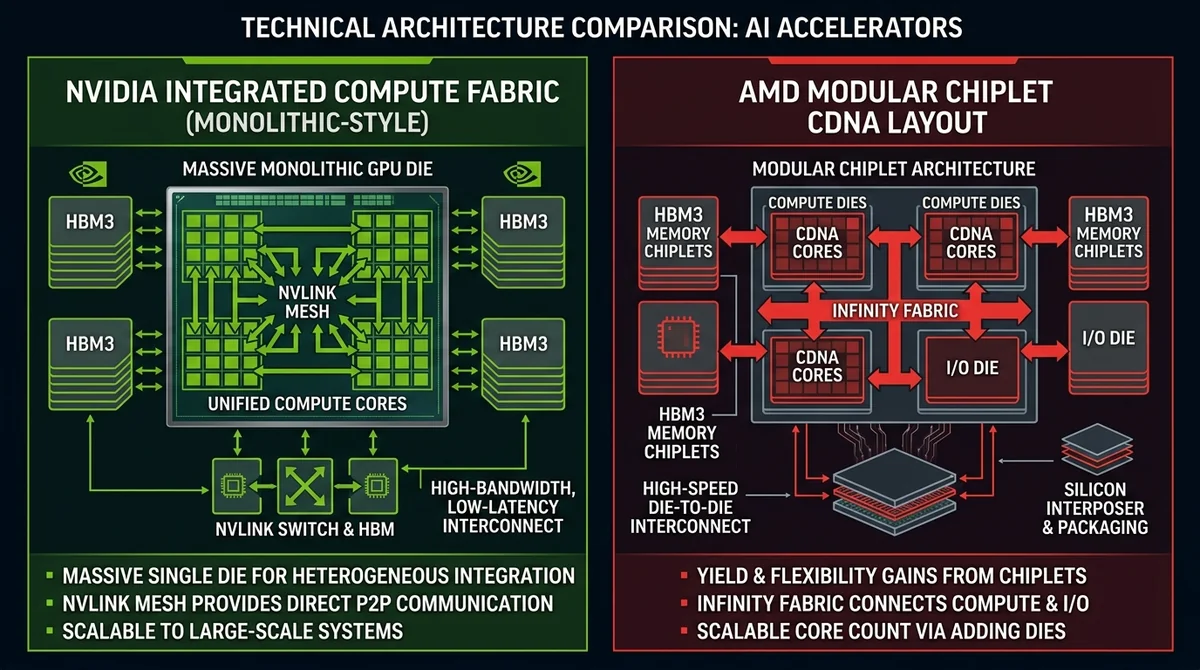
NVIDIA and AMD approach data center AI acceleration with fundamentally distinct engineering philosophies, balancing unified monolithic designs against modular multi-chip architectures.
#Hardware Compute Profiles and Theoretical Throughput
NVIDIA's flagship data center GPUs rely on dedicated Tensor Core architectures optimized for low-precision floating-point arithmetic (such as FP8 and FP4), maximizing throughput for large language model (LLM) training and real-time inference. In contrast, AMD’s Instinct accelerator series leverages modular chiplet designs (CDNA architecture), allowing AMD to scale compute units flexibly while maintaining manufacturing yield efficiencies across advanced semiconductor nodes. For investors comparing broader semiconductor dynamics, analyzing Nvidia vs AMD vs Broadcom highlights how different hardware approaches shape market positioning.
#Memory Bandwidth, High-Bandwidth Memory (HBM), and Interconnects
Multi-node clustering performance depends heavily on interconnect bandwidth and onboard memory capacity:
- Interconnect Topology: NVIDIA utilizes proprietary NVLink technology, enabling ultra-fast, low-latency inter-GPU communication across unified clusters. AMD deploys Infinity Fabric, designed to bridge CPU-to-GPU and GPU-to-GPU channels seamlessly across heterogeneous server racks.
- HBM Integration: AMD frequently targets market differentiation by packing higher total High-Bandwidth Memory (HBM) capacity per package, allowing entire LLMs to fit into fewer accelerators. NVIDIA counters this by optimizing memory bandwidth efficiency through proprietary caching hierarchies.
| Specification Dimension | NVIDIA Flagship Data Center Architecture | AMD Instinct Accelerator Architecture |
|---|---|---|
| Architecture Style | Vertically integrated compute fabric | Modular chiplet (CDNA) framework |
| Interconnect Standard | NVLink (Proprietary ultra-dense mesh) | Infinity Fabric (Heterogeneous interconnect) |
| Memory Strategy | Balanced density with deep cache hierarchy | Maximized raw HBM capacity per accelerator |
| Primary Optimization Target | End-to-end multi-node scaling | Single-node memory capacity & compute density |
#What Are the Core Differences Between CUDA and ROCm Software Ecosystems?
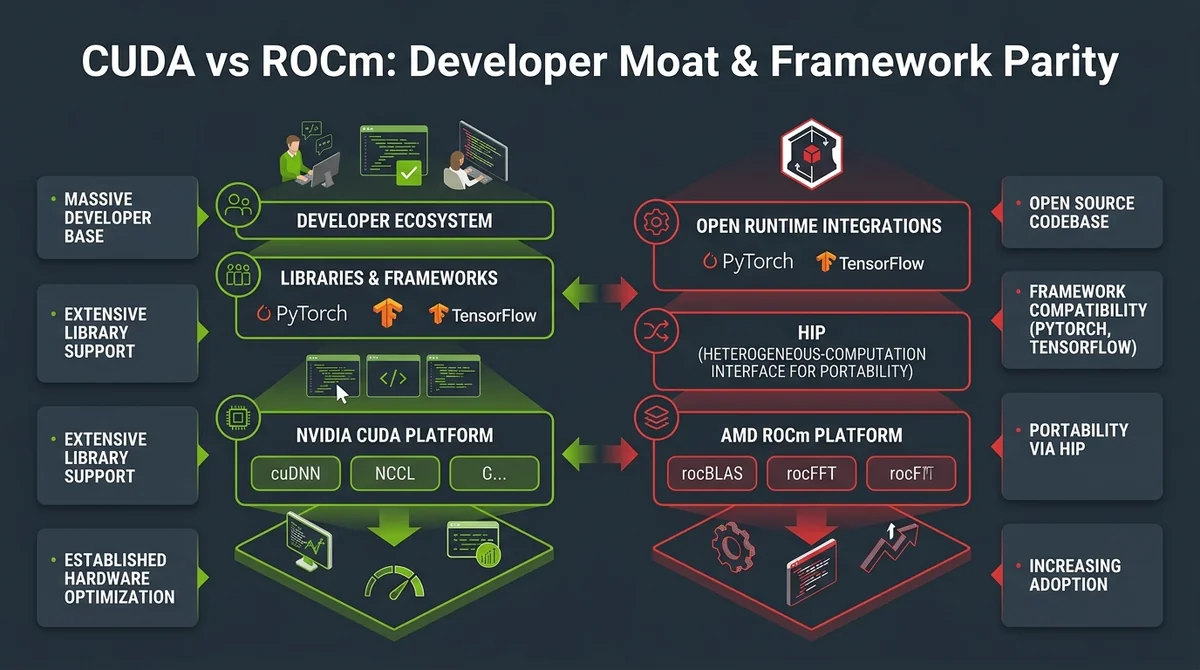
Software ecosystems represent the primary competitive barrier in enterprise AI, determining real-world hardware utilization and migration costs.
#Developer Tooling and Framework Native Support
NVIDIA’s proprietary CUDA platform provides a mature software moat with turnkey framework optimization, whereas AMD’s ROCm offers an open-source alternative aimed at reducing vendor lock-in. For over a decade, artificial intelligence research and commercial libraries have defaulted to CUDA primitives, giving NVIDIA immediate day-one compatibility with new model architectures. AMD’s ROCm ecosystem has evolved substantially by partnering directly with the PyTorch Foundation and major AI platforms, ensuring out-of-the-box support for mainstream training and inference pipelines without requiring extensive kernel rewrites.
#Proprietary Optimization vs Open-Source Portability
Choosing between CUDA and ROCm involves balancing proprietary convenience against platform flexibility:
- CUDA Ecosystem: Delivers highly tuned libraries (cuDNN, TensorRT, NCCL) that extract peak floating-point utilization from NVIDIA hardware with minimal engineering friction.
- ROCm Ecosystem: Emphasizes open-source portability, enabling hyperscalers and cloud service providers (CSPs) to customize compiler pipelines and avoid vendor lock-in.
- Switching Overhead: While code-level translation tools (such as HIP) simplify porting CUDA code to ROCm, enterprises with complex legacy infrastructure still face validation overhead during migration.
#How Do Enterprise Deployment Costs and Availability Differ Between NVDA and AMD?
Enterprise procurement teams evaluate AI accelerators by balancing capital expenditure premiums against long-term operational efficiency.
#Hardware Acquisition and Lead Times
NVIDIA’s dominant market position commands strong pricing power, resulting in premium hardware acquisition costs and historically tighter supply chain allocations during peak demand cycles. AMD positions its Instinct family as an accessible, high-volume alternative, offering competitive lead times and compelling price-to-performance terms to attract hyperscalers and tier-two cloud providers. Market participants evaluating equity exposure often explore stocks similar to NVDA or assess whether AMD stock can catch up with Nvidia to understand pricing power differentials.
#Total Cost of Ownership (TCO) and Energy Efficiency
Evaluating enterprise AI infrastructure requires analyzing holistic TCO beyond initial purchase prices:
- Power Consumption per Inference Cycle: NVIDIA's tightly coupled system architecture (including integrated networking) delivers high performance-per-watt efficiency in hyperscale data centers.
- Compute Density per Dollar: AMD’s larger memory footprint per chip allows enterprises to reduce the total number of physical nodes required to serve specific large models, reducing rack space and cooling infrastructure overhead.
- Engineering Maintenance Costs: CUDA’s widespread developer familiarity lowers engineering onboarding costs, whereas adopting ROCm may require dedicated performance engineering teams.
#NVDA vs AMD AI: Which Strategic Profile Fits Your Exposure Framework?
Selecting asset exposure between NVDA and AMD in the AI sector balances established market dominance and margin defense against challenger growth upside and open-ecosystem adoption. NVIDIA functions as an entrenched market leader characterized by premium gross margins, enterprise software lock-in, and comprehensive full-stack solutions ranging from silicon to networking. AMD represents a disciplined challenger dynamic, capturing market share by solving memory bottlenecks and providing cost relief to capital-constrained hyperscalers.
#Market Leadership and Pricing Power vs Market Share Expansion
Investors seeking exposure to enterprise AI infrastructure must weigh these distinct operational profiles:
- NVIDIA Profile: Suited for portfolios prioritizing proven pricing power, software network effects, and full-stack data center integration across leading cloud platforms. Users exploring tokenized equity access can reference NVIDIA tokenized stock exchange rankings for multi-asset trading alternatives.
- AMD Profile: Suited for frameworks targeting asymmetric market share expansion, open-source infrastructure shifts, and multi-vendor diversification among tier-one cloud providers.
#Execution Risks in the Competitive AI Hardware Landscape
Both semiconductor designers face strategic headwinds. NVIDIA must defend its enterprise software moat against open-source compiler advancements and custom in-house ASICs developed by major cloud providers. Meanwhile, AMD must continually accelerate ROCm software adoption and secure advanced packaging capacity to maintain multi-node scaling parity at hyperscale volume.
#Disclaimer
This article is provided for informational and educational purposes only and does not constitute financial, investment, or technical advice. The performance, software compatibility, and hardware availability of semiconductor assets are subject to market dynamics and vendor updates. Always conduct independent due diligence before making investment or infrastructure procurement decisions.
FAQ
What is the primary architectural difference between NVDA and AMD AI accelerators?
NVIDIA focuses on vertically integrated systems with proprietary NVLink interconnects and low-precision Tensor Cores, while AMD emphasizes modular chiplet architectures with high onboard High-Bandwidth Memory (HBM) capacity.
Can AMD ROCm run PyTorch and TensorFlow models without modification?
Yes, modern versions of ROCm provide native integration with major deep learning frameworks like PyTorch, enabling standard AI models to train and run inference with minimal to no code modifications.
Why does NVIDIA maintain a higher pricing premium in enterprise AI?
NVIDIA commands higher pricing due to its mature CUDA software ecosystem, validated end-to-end networking solutions, and a multi-year head start in developer adoption that minimizes enterprise deployment friction.
How does AMD compete against NVIDIA in data center total cost of ownership (TCO)?
AMD competes by offering higher memory capacity per accelerator, enabling enterprises to deploy fewer physical nodes for large language models, alongside aggressive hardware acquisition pricing and shorter lead times.
Done comparing? Ready to place your first trade?
The crypto assets, tokenized US stocks and ETFs you just compared are all tradable on MSX — spot or perpetuals.
Quick Start Trading →New here? Registration takes three quick steps.