Nvidia vs AMD vs Broadcom: Broadcom Tops 2026 AI Chip Stocks
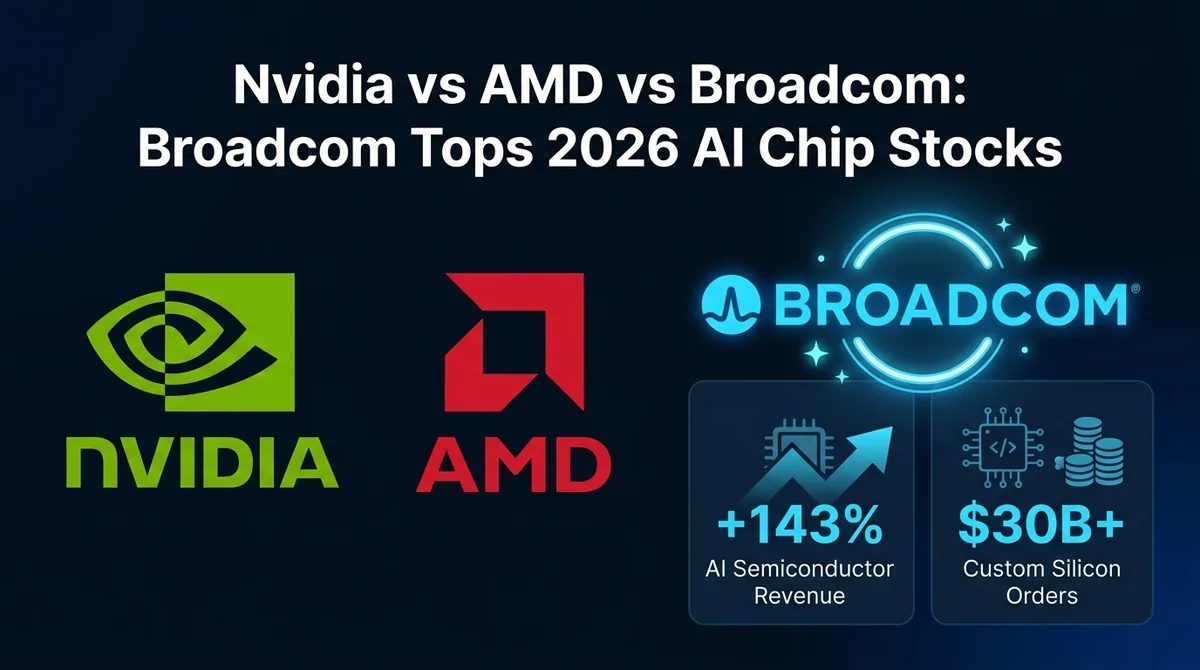
Broadcom's 143% AI revenue growth and $30B+ orders make it the top AI chip stock after Nvidia. Compare financials and risks to pick 2026's best AI investment.
#Nvidia vs AMD vs Broadcom: Broadcom Tops 2026 AI Chip Stocks
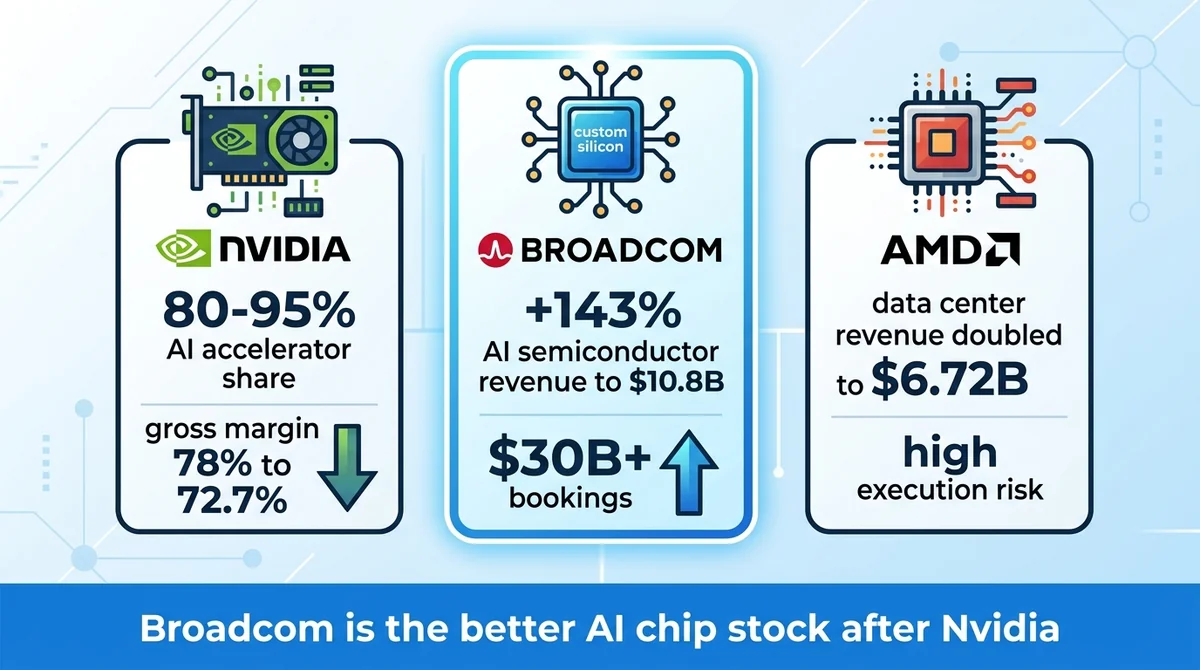
In the Nvidia vs AMD vs Broadcom comparison for 2026, Broadcom is the better AI chip stock after Nvidia. Its 143% AI semiconductor revenue surge and $30B+ custom silicon orders provide earnings visibility, while Nvidia faces gross margin compression and AMD carries higher execution risk after a 193% stock run.
Key Takeaways
- Nvidia still leads AI training with 80–95% AI accelerator share and a 107% ROE, but its gross margin has fallen from 78% to 72.7%.
- Broadcom's Q2 FY2026 AI semiconductor revenue jumped 143% to $10.8B, with $30B+ bookings and a 26/30 financial health score.
- AMD's data center revenue doubled to $6.72B, but its head-on GPU fight and 193% one-year stock gain leave little room for error.
- The Motley Fool concludes Broadcom is likely the better AI chip stock after Nvidia.
#Nvidia: Training King Faces Gross Margin Pressure
Nvidia still dominates AI training with 80–95% share of AI accelerators and a 107% return on equity, according to StocksReport. However, its gross margin has compressed from a peak of 78% to 72.7%, a signal that the company is transitioning from an emerging monopoly to a mature oligopoly as custom ASIC competition intensifies.
The CUDA software moat locks in AI developers, but the rise of Broadcom's custom XPUs and AMD's rival GPUs threatens Nvidia's pricing power. Nvidia retains a net cash position and outstanding profitability, which is why many investors still consider it the core AI holding. For a ranking of platforms that offer tokenized exposure to Nvidia, see our NVIDIA tokenized stock exchanges ranking.
#Broadcom: Custom XPU Order Visibility and Networking Toll
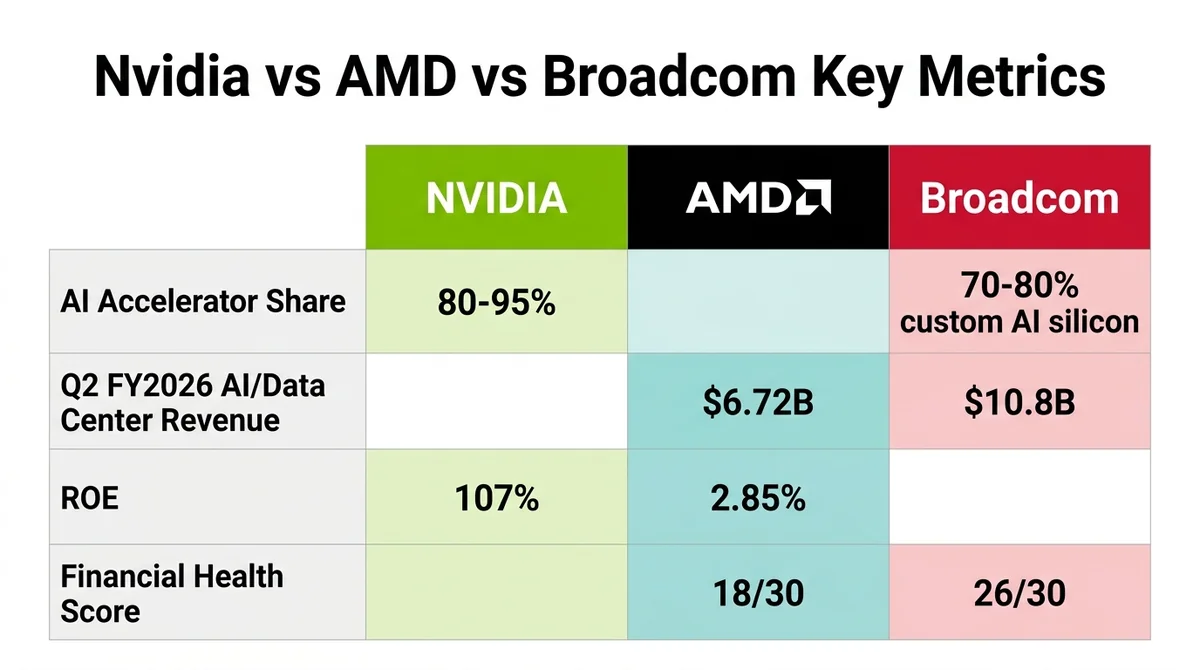
Broadcom's AI semiconductor revenue surged 143% year over year to $10.8 billion in Q2 FY2026, while total revenue hit $22.19 billion, according to Yahoo Finance. Management guided Q3 AI revenue to $16 billion, a more than 200% jump, and full-year AI semiconductor revenue to $56 billion with visibility to 2028. That order visibility makes Broadcom a more predictable AI investment than AMD.
Broadcom sidesteps the merchant GPU fight by designing custom XPUs for Google, Meta, OpenAI, and Anthropic, holding 70–80% of the custom AI silicon market. Its Ethernet fabric (Tomahawk 6, Jericho 4) stitches 100,000-GPU clusters, with networking accounting for almost 40% of Q2 AI revenue. AI bookings above $30 billion against $10.8 billion shipped show strong demand, and the VMware transformation now generates 70% operating margins versus 20% pre-acquisition. With a financial health score of 26/30, Broadcom is the clear second-place AI franchise, as highlighted in our AI stocks buy or avoid ranking.
#AMD: Head-On GPU Challenger with Execution Risk
AMD's data center revenue more than doubled to $6.72 billion in Q2 FY2026, swinging segment operating income from a $155 million loss to $2.10 billion, according to Yahoo Finance. The company is supplying Meta Platforms with 6 gigawatts of Instinct GPUs and collaborating with Anthropic on up to 2 GW of MI450 accelerators in Helios racks, with Microsoft also scaling Helios on Azure.
Technically, AMD is credible: ROCm 7.0 offers 30% better inference performance than CUDA, and the MI355X integrates 288GB of memory versus 141GB for Nvidia's H200, with energy efficiency improved 38 times, per StocksReport. Yet AMD's 193% one-year stock run leaves little margin for execution error, and its financial health score is only 18/30 with a 2.85% ROE. Investors seeking a deep dive into NVDA vs TSMC or tokenized stock mechanics can review our NVDA tokenized stock contract vs real NVDA stock comparison.
#Financial Comparison: Nvidia vs AMD vs Broadcom
The three companies have very different profit engines. Nvidia earns from merchant GPUs and the CUDA software moat; Broadcom collects a networking toll on every hyperscaler build plus custom silicon design; AMD competes head-on with general-purpose GPUs. The table below summarizes key metrics from the latest quarters.
| Metric | Nvidia | Broadcom | AMD |
|---|---|---|---|
| AI revenue growth (Q2 FY2026) | Leads with 80–95% AI accelerator share | +143% to $10.8B | +107% to $6.72B |
| Profitability | ROE 107%, net cash | FCF $21.9B, EBITDA margin 62% | ROE 2.85% |
| Competitive positioning score | 100 | 87 | 80 |
| Key risk | Gross margin fell from 78% to 72.7% | Hyperscaler concentration | 193% stock run, execution |
Statista estimates the AI chip market will reach $333 billion by the end of the decade, leaving room for multiple winners. Broadcom's custom silicon and networking model gives it earnings visibility that AMD's merchant GPU strategy lacks.
#Which AI Chip Stock Is the Better Buy in 2026?
Broadcom is likely the better AI chip stock after Nvidia, according to The Motley Fool. Its $30B+ AI bookings against $10.8B shipped, plus Hock Tan's $56B full-year guidance, make it Nvidia's biggest threat without competing for a single merchant GPU sale. Nvidia remains the dominant AI training play, but its gross margin decline is a warning sign. AMD is a credible challenger, yet its valuation leaves no room for error.
For investors evaluating tokenized exposure to these AI chip stocks, our NVIDIA tokenized stock exchanges ranking and NVDA tokenized stock contract vs real NVDA stock comparison provide platform-level diligence.
#Key Risks and Opportunities to Watch
- Nvidia: Watch gross margin trend (already down from 78% to 72.7%) and custom ASIC share shifts. A recovery in training demand could restore margins, but rising competition may cap upside.
- Broadcom: Q3 AI revenue target of $16B (+200%+) and full-year $56B guidance are key. VMware integration and networking growth provide upside, but hyperscaler concentration is a risk.
- AMD: Sustaining data center operating income after turning positive is crucial. Gaming revenue fell 31%, showing mixed momentum.
- Common driver: Hyperscaler capex from Meta, Microsoft, Google, OpenAI, and Anthropic remains the shared tailwind.
For a detailed breakdown of trading Nvidia via tokenized contracts versus traditional shares, see our NVDA tokenized stock contract vs real NVDA stock comparison.
FAQ
Which AI chip stock is the best buy in 2026?
Broadcom is likely the better AI chip stock after Nvidia, thanks to its custom silicon leadership and $30B+ AI bookings, though Nvidia remains the dominant training player.
How does Broadcom compare to Nvidia and AMD in AI revenue?
Broadcom's AI semiconductor revenue hit $10.8B in Q2 FY2026, up 143% YoY, while AMD's data center revenue doubled to $6.72B; Nvidia still leads with 80–95% AI accelerator share.
What are the main risks for Nvidia stock?
Nvidia's gross margin has fallen from 78% to 72.7%, and custom ASIC competition from Broadcom and others could erode its AI accelerator dominance.
Can AMD catch up to Nvidia in AI chips?
AMD has credible technical gains with ROCm 7.0 and MI355X, but its head-on GPU fight and 193% stock run leave little room for execution error.
What should investors watch in the next AI chip earnings cycle?
Key metrics include Broadcom's Q3 AI revenue guidance of $16B, AMD's data center operating income sustainability, and Nvidia's gross margin trend.
Related Terms
Done comparing? Ready to place your first trade?
The crypto assets, tokenized US stocks and ETFs you just compared are all tradable on MSX — spot or perpetuals.
Quick Start Trading →New here? Registration takes three quick steps.