Beyond Intel vs TSMC: A Three-Way Comparison of Advanced Node and Packaging Exposure in 2026 (Samsung and MU Enter the Picture)
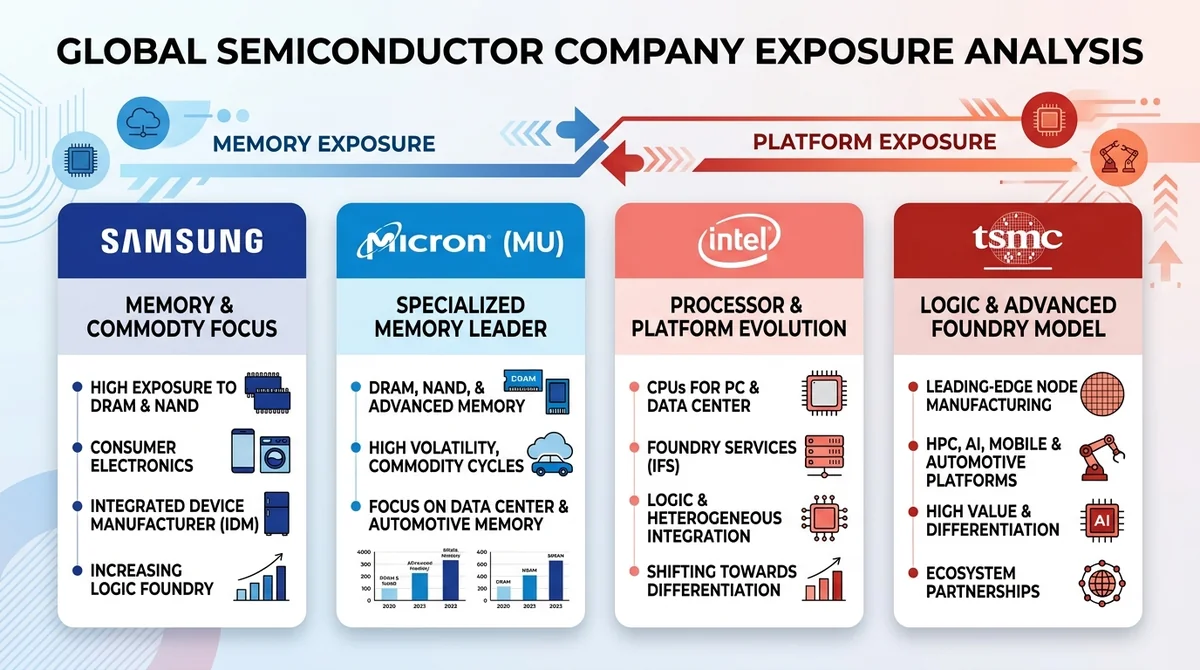
Beyond Intel and TSMC: Samsung offers combined foundry-plus-memory exposure, while MU offers memory-linked packaging exposure. A four-way structural comparison.
Bottom line: If you want to cover logic foundry and advanced packaging capacity, benchmark against Samsung first; if you want to cover the memory cycle and memory-related packaging, benchmark against MU first — these are two different exposures, not an either-or choice.
#Beyond Intel vs TSMC, why also look at Samsung and MU?
Intel and TSMC have long been the two most frequently cited foundry benchmarks in advanced-node discussions. But stopping at these two leaves out two entirely different types of exposure: platform companies that run both logic foundry and memory businesses (Samsung), and companies whose exposure is concentrated in memory and its related packaging (MU).
Samsung's role: Samsung operates both logic foundry and memory businesses, with advanced-node and advanced packaging exposure spanning both sides — a composite exposure.
Why MU enters the packaging discussion: MU's business is primarily memory, and its advanced packaging exposure is concentrated in memory-related packaging, rather than in general-purpose advanced packaging platforms on the logic foundry side.
How the three-way comparison differs from looking only at Intel and TSMC: Looking at just two foundries yields a single-dimension view of node competition; adding Samsung and MU expands the comparison to "platform exposure vs memory exposure," distinguishing differences in business boundaries, cyclical attributes, and customer structure.
Note that this article only compares business structure and exposure types, without any specific capacity or share figures; relevant data should defer to each company's public disclosures, and anything undisclosed is marked as data not disclosed.
#What are the key differences between Samsung's and MU's advanced-node and packaging exposure?
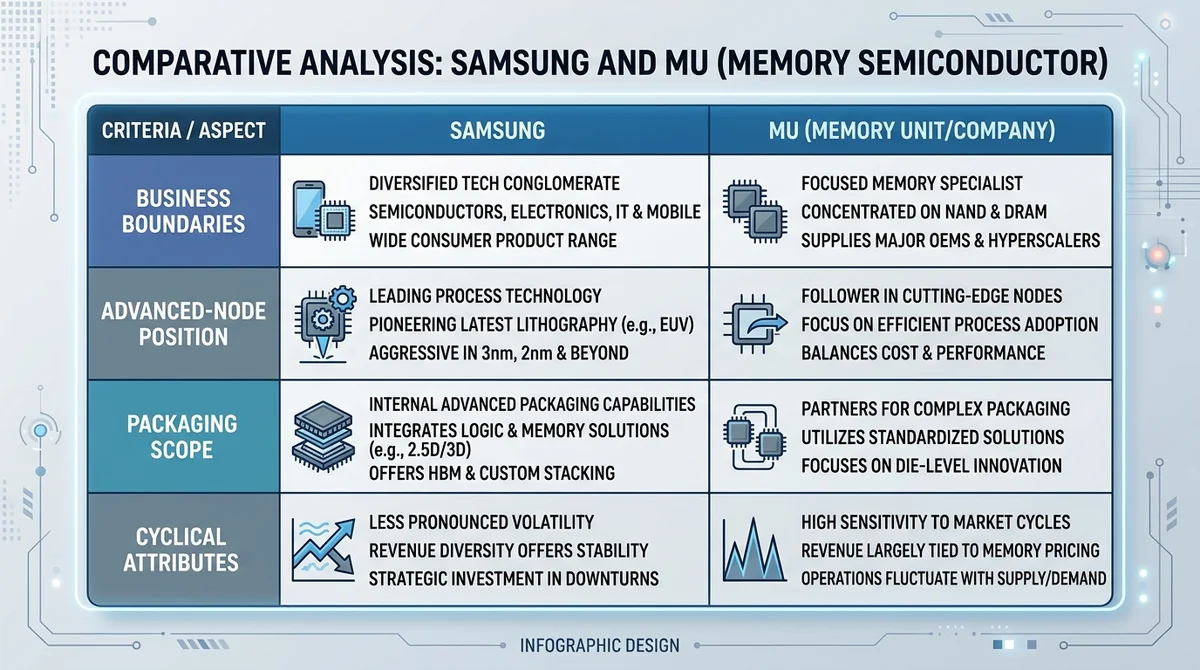
#Business boundaries: foundry platform vs memory-focused
Samsung covers both logic foundry and memory businesses, giving it a more composite exposure structure; MU is primarily memory, giving it a more concentrated exposure. This difference determines that the two behave differently through cycles: the former is affected by both foundry orders and memory prices, while the latter follows the memory cycle more directly.
#Which side does advanced-node exposure fall on
Samsung's advanced-node exposure falls mainly on the logic foundry side; MU's advanced-node exposure falls on the memory process side. Although both involve the term "advanced node," they point to different process targets and customer groups and cannot be directly compared side by side.
#How to distinguish advanced packaging capacity exposure
Samsung's advanced packaging covers multiple packaging formats, serving both the logic foundry and memory lines; MU's advanced packaging is concentrated in memory-related packaging. When assessing packaging exposure, first ask "which type of chip does this packaging serve" rather than looking only at the packaging technology name.
#Which dimensions to use for foundry exposure comparison
Five dimensions are recommended: business structure, process position, packaging type, customer structure, and cyclical attributes. These five dimensions cover most structural differences and do not depend on undisclosed capacity figures.
#How to compare the exposure of Samsung, MU, Intel, and TSMC?
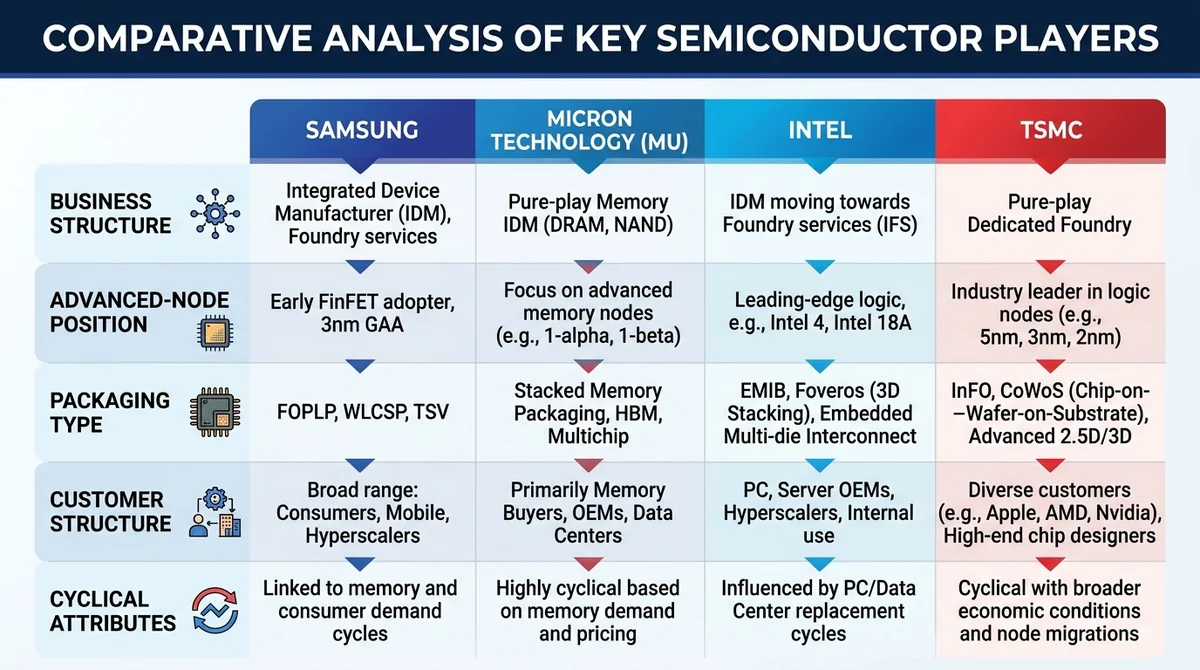
When putting all four into one table, organize by the following dimensions, uniformly marking missing data as data not disclosed and not citing undisclosed capacity or share figures.
| Dimension | Samsung | MU | Intel | TSMC |
|---|---|---|---|---|
| Business structure | Logic foundry + memory | Primarily memory | Logic foundry + own products | Primarily logic foundry |
| Advanced-node position | Logic foundry side | Memory process side | Logic foundry side | Logic foundry side |
| Advanced packaging type | Covers multiple advanced packaging formats | Concentrated in memory-related packaging | Data not disclosed | Data not disclosed |
| Foundry exposure | Yes | Data not disclosed | Yes | Yes |
| Memory exposure | Yes | Yes | Data not disclosed | Data not disclosed |
| Customer structure | Data not disclosed | Data not disclosed | Data not disclosed | Data not disclosed |
| Cyclical attributes | Dual foundry + memory cycle | Primarily memory cycle | Primarily foundry cycle | Primarily foundry cycle |
| Disclosure basis | Per company disclosures | Per company disclosures | Per company disclosures | Per company disclosures |
The difference between platform and memory exposure: Platform exposure is exposed to both the logic and memory lines simultaneously, with more diversified sources of volatility; memory exposure is more concentrated and more directly sensitive to the memory price cycle.
Which data should defer to company disclosures: Capacity, share, customer concentration, capex cadence, and similar items should all defer to companies' periodic reports and public statements. This article does not provide these figures, and missing items are uniformly marked as data not disclosed.
#If you focus on foundry and packaging exposure, should you choose Samsung or MU?
If you are a user who wants to cover logic foundry and advanced packaging capacity, benchmark against Samsung first, because its exposure covers both the logic foundry side and multiple advanced packaging formats.
If you are a user who wants to cover memory price elasticity and memory-related packaging, benchmark against MU first, because its exposure is more concentrated in memory and its related packaging.
If you are a user who wants to understand both types of exposure, treat Samsung and MU as complementary rather than substitutes: one provides a platform perspective, the other a memory perspective.
If you are a user already tracking Intel and TSMC, add Samsung to the comparison to complete the "foundry + memory" dual-exposure perspective, and add MU to complete the memory-cycle perspective.
If you are a user who only cares about a single process node, this article's exposure comparison framework offers limited help, and you should turn to public materials on specific technology nodes.
#What risks and disclosure-basis issues should you watch when comparing these exposures?
Exposure comparison is not buy or sell advice: This article describes business structure and exposure types and does not constitute any investment conclusion.
Inconsistent disclosure bases introduce bias: Companies classify business segments and packaging types differently, so cross-comparisons must note sources and definitions, or figures based on different definitions may be placed side by side.
Different cyclical attributes cannot be simply juxtaposed: Foundry cycles and memory cycles have different drivers, and directly comparing the revenue volatility of the two types of companies would be misleading.
Handling missing data: All figures defer to public disclosures, undisclosed items are written as data not disclosed, and estimates are not used as substitutes.
To view the original official disclosures of each company, refer to their investor relations pages at the end of this article.
This content is compiled from public data and does not constitute investment or open account advice. Data is as of 2026-01-01 and actual conditions may change.
FAQ
Is Samsung's and MU's advanced packaging exposure the same type?
No. Samsung's advanced packaging covers multiple packaging formats, serving both the logic foundry and memory lines; MU's advanced packaging is concentrated in memory-related packaging. You should first confirm which type of chip the packaging serves.
Why include MU in the advanced packaging discussion?
Because MU's business is primarily memory, and its packaging exposure is closely tied to memory processes. Including it in the comparison completes the "memory-type packaging exposure" perspective, rather than discussing only packaging on the logic foundry side.
Can Samsung and MU substitute for each other?
No. Samsung is a platform-type exposure combining logic foundry and memory, while MU is a concentrated exposure primarily in memory. Their exposures do not overlap and are complementary rather than substitutable.
Where are the capacity and share figures in the four-way comparison table?
This article does not cite undisclosed capacity or share figures. Relevant data should defer to each company's periodic reports and public statements, and missing items are uniformly marked as data not disclosed.
What is the difference between the foundry cycle and the memory cycle?
Their drivers differ: the foundry cycle is more affected by node advancement and customer order cadence, while the memory cycle is more affected by supply-demand and price fluctuations. Directly juxtaposing the revenue volatility of the two types of companies can be misleading.
Related Terms
Done comparing? Ready to place your first trade?
The crypto assets, tokenized US stocks and ETFs you just compared are all tradable on MSX — spot or perpetuals.
Quick Start Trading →New here? Registration takes three quick steps.