Top 10 Semiconductor Stocks: Best Chipmakers to Watch in 2026
Explore the top 10 semiconductor stocks driving the AI era. Compare leaders like Nvidia, TSMC, and ASML, and evaluate ETF versus fractional trading routes.
#Top 10 Semiconductor Stocks: Best Chipmakers to Watch in 2026
The top 10 semiconductor stocks encompass global market leaders across AI chip design, foundry manufacturing, and equipment production, led by Nvidia, TSMC, Broadcom, ASML, AMD, Samsung, Qualcomm, Micron, Intel, and Texas Instruments. These companies form the foundational hardware infrastructure for artificial intelligence, cloud computing, automotive electrification, and global mobile connectivity.
#Key Takeaways
- AI Infrastructure Backbone: Semiconductor chips serve as the primary engine for generative AI, data centers, 5G networking, and electric mobility.
- Segmented Value Chain: The industry is divided into fabless designers (Nvidia, AMD), pure-play foundries (TSMC), integrated device manufacturers (Samsung, Intel), and photolithography suppliers (ASML).
- High Volatility & Corrections: Chip equities frequently experience periodic 20% to 30% pullbacks due to cyclical demand swings and geopolitical constraints.
- Flexible Access: Modern trading venues like MSX allow investors to access high-priced semiconductor stocks through fractional shares starting from 10 USDT with T+0 settlement.
#Why Are Semiconductor Stocks the Foundational Pillar of the AI Era?
Semiconductor stocks represent companies that design, fabricate, and supply equipment for microchips powering artificial intelligence, electric mobility, and global cloud infrastructure across specialized business models. Without advanced silicon, modern computational expansion—from large language models to autonomous driving suites—would grind to a halt.
+--------------------------------------------------------------------------+
|                     Semiconductor Value Chain Models                     |
+--------------------+-----------------------------------------------------+
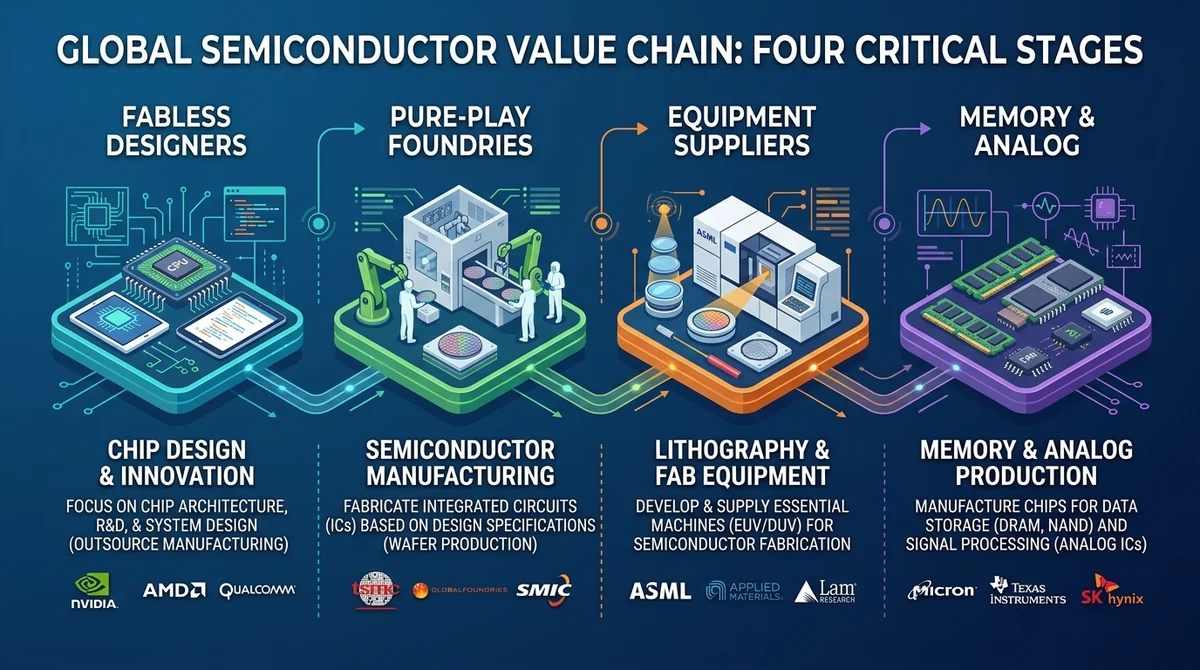
| Fabless Designers  | Focus on chip architecture and R&D (NVDA, AMD, QCOM)|
| Pure Foundries     | Dedicated contract manufacturing at scale (TSMC)    |
| Equipment Makers   | Critical lithography and etching tools (ASML, Lam)  |
| Memory & Analog    | Storage hardware & embedded power circuits (MU, TXN)|
+--------------------+-----------------------------------------------------+
#What core catalysts are driving long-term semiconductor demand?
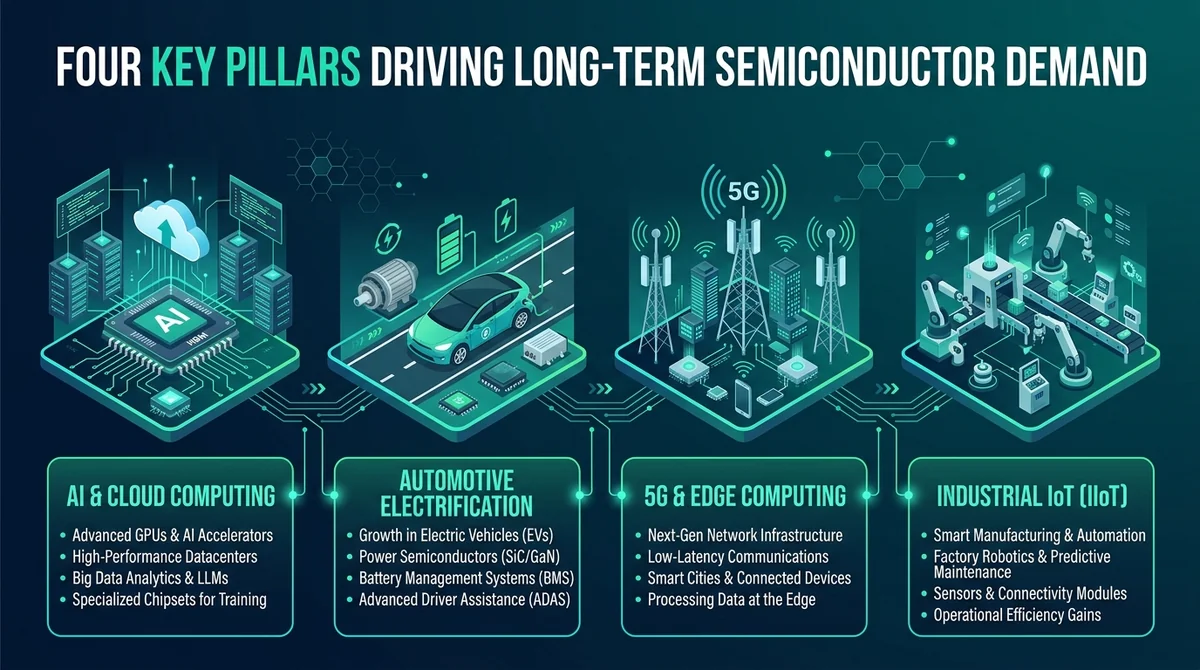
Long-term semiconductor demand is propelled by structural tailwinds across multiple high-growth industries:
- Artificial Intelligence & Hyperscale Cloud: Training and inference workloads require specialized graphics processing units (GPUs) and custom application-specific integrated circuits (ASICs).
- Automotive Electrification: Modern electric vehicles utilize complex power management and microcontroller chips for battery regulation and driver assistance systems.
- 5G and Edge Computing: High-speed telecommunications infrastructure demands low-latency microprocessors and radio-frequency chips.
- Industrial IoT and Automation: Smart factory hardware relies on microcontrollers and embedded analog circuits for continuous sensing and control.
#How is the semiconductor supply chain segmented across business models?
The global semiconductor ecosystem is divided into specialized, interdependent models. Fabless designers such as Nvidia and AMD focus on computational R&D while outsourcing physical production. Pure-play foundries like Taiwan Semiconductor Manufacturing Company (TSMC) handle complex fabrication at leading-edge nanometer nodes. Specialized toolmakers, prominently ASML, supply extreme ultraviolet (EUV) lithography systems without which advanced chip manufacturing cannot occur.
#What Are the Top 10 Semiconductor Stocks to Watch?
The top semiconductor stocks globally are led by market-cap giants Nvidia and TSMC, supported by equipment leaders like ASML and diversified innovators such as Broadcom, AMD, Qualcomm, Micron, and Intel. Below is an overview of the 10 industry leaders driving modern computing.
| Company | Ticker | Primary Specialization | Key Competitive Advantage |
|---|---|---|---|
| Nvidia | NVDA | AI Accelerators & GPUs | Dominant CUDA software moat and computing platforms |
| TSMC | TSM | Dedicated Foundry | Indispensable global leader in sub-5nm fabrication nodes |
| Broadcom | AVGO | Custom Silicon & Networking | Mission-critical enterprise networking and custom ASIC design |
| ASML Holding | ASML | Photolithography Equipment | Near-monopoly in extreme ultraviolet (EUV) lithography systems |
| AMD | AMD | CPUs, GPUs & DPUs | Strong enterprise server market presence with EPYC processors |
| Samsung Electronics | 005930.KS | Memory & Foundry | Vast scale in dynamic RAM, NAND flash, and consumer hardware |
| Qualcomm | QCOM | Mobile & Wireless SoCs | Dominant standard-essential patents in 5G and mobile processors |
| Micron Technology | MU | High-Bandwidth Memory (HBM) | Essential DRAM and NAND storage hardware for AI accelerators |
| Intel | INTC | x86 Processors & Foundry Turnaround | Massive historical x86 enterprise base and fabrication initiatives |
| Texas Instruments | TXN | Analog & Embedded Processing | Broad catalog of resilient, industrial power-management chips |
#Which companies lead AI chip design and high-performance computing?
Nvidia remains the undisputed leader in high-performance computing and enterprise AI infrastructure, backed by its comprehensive hardware ecosystem and proprietary software stack. Nvidia vs AMD vs Broadcom highlights the competitive dynamics among top fabless designers, with Broadcom gaining substantial market share in custom AI accelerators and AMD challenging enterprise data center footprints through its Instinct accelerator lineup.
#Which foundries and equipment makers dominate advanced chip manufacturing?
TSMC produces the vast majority of the world's most advanced microprocessors, serving as the sole fabrication partner for major fabless chipmakers. Evaluating TSMC vs Intel stock reveals how TSMC's pure-play operational model has outpaced legacy integrated manufacturers in yield efficiency and node transitions. Powering this manufacturing supremacy is ASML, the Netherlands-based photolithography leader whose EUV equipment is essential for producing sub-5nm nodes.
#Which diversified chipmakers supply essential industrial and mobile technologies?
Beyond pure compute engines, mobile and memory specialists provide indispensable hardware. Qualcomm powers premium smartphone ecosystems with Snapdragon platforms, while Micron Technology and SK Hynix deliver high-bandwidth memory (HBM) crucial for feeding data into AI accelerators. In comparative terms, analyzing Nvidia vs Micron demonstrates how memory supply constraints directly influence overall accelerator output. Simultaneously, Texas Instruments provides resilient analog power-management microchips across industrial and automotive sectors.
#Should You Invest in Single Semiconductor Stocks or Semiconductor ETFs?
Choosing between individual semiconductor equities and sector-wide exchange-traded funds (ETFs) depends on an investor's risk appetite, analytical capability, and return targets.
+--------------------------------------------------------------------------+
|                       Direct Stocks vs. Sector ETFs                      |
+---------------------+----------------------------------------------------+
| Single Stocks       | High upside potential; exposed to single-firm risk |
| Sector ETFs         | Broad diversification; dampens firm-specific shocks|
| Return Profile      | Concentrated outperformance vs. benchmark tracking |
| Volatility Exposure | High single-node risk vs. blended sector volatility|
+---------------------+----------------------------------------------------+
#How does individual stock picking compare with sector ETF diversification?
Investing in individual stocks like NVDA vs TSMC offers direct upside from proprietary technological breakthroughs and market share expansion. However, company-specific execution issues—such as production delays or lost hyperscaler contracts—can result in sharp drawdowns. Semiconductor ETFs aggregate dozens of designers, foundries, and material suppliers, significantly reducing single-stock downside while tracking general sector expansion.
#What criteria should investors use to evaluate semiconductor companies?
When assessing chip companies, institutional and retail investors typically analyze:
- Technological Moat: Proprietary instruction sets, patent density, and software ecosystem lock-in.
- Operating Margins and R&D Reinvestment: Sustained gross margins above 50% coupled with heavy R&D expenditure to maintain node leadership.
- Secular AI Exposure: Revenue proportion generated from high-margin data centers and enterprise AI workloads.
- Customer Concentration: Level of dependency on a handful of mega-cap cloud providers.
#How Can You Trade Top Semiconductor Stocks Efficiently?
Modern digital asset venues and tokenization platforms provide streamlined alternatives to traditional brokerages for accessing semiconductor equities.
#What are the benefits of fractional shares for high-priced chip stocks?
High-performing semiconductor leaders often trade at elevated nominal share prices, making portfolio balancing difficult for smaller accounts. Platforms like MSX address this friction by offering fractional share trading starting at just 10 USDT. This structure enables capital-efficient exposure to premium blue-chips such as Nvidia and Broadcom without committing thousands of dollars per lot.
#How does on-chain tokenization enable stablecoin settlement for equity exposure?
Tokenized equity protocols eliminate the barriers of traditional international brokerage accounts. Through on-chain equity spot markets, traders can deploy stablecoins directly to gain equity exposure with T+0 instant settlement, bypassing international wire transfer fees. With transparent custodial architectures maintaining greater than 100% physical reserve backing and multi-asset margin capabilities, investors can navigate market movements with optimal capital flexibility.
#What Key Risks and Volatility Factors Affect Semiconductor Stocks?
Semiconductor equities are historically among the most cyclical and volatile assets in public equity markets, demanding careful risk management.
#How do geopolitical and supply chain tensions impact chipmakers?
Advanced chip manufacturing remains geographically concentrated in East Asia, creating systemic vulnerability to geopolitical disruptions, export controls, and supply bottleneck risks. Trade restrictions on high-performance compute chips directly constrain revenue streams for international designers and equipment manufacturers.
#Why do semiconductor equities experience periodic 20-30% corrections?
Semiconductor stocks frequently experience 20% to 30% corrections even during broader bull cycles. These pullbacks stem from inventory digestion phases, fluctuating capital expenditure budgets among enterprise hyperscalers, and shifts in broader macroeconomic liquidity. Investors aiming for long-term semiconductor gains should adopt defined position-sizing rules and prepare for cyclical volatility.
FAQ
What is the largest semiconductor company by market capitalization?
Nvidia is the world's largest semiconductor company by market capitalization, primarily driven by its dominant market share in graphics processing units (GPUs) and specialized AI computing accelerators.
What is the difference between a fabless chipmaker and a semiconductor foundry?
A fabless chipmaker (like Nvidia or AMD) designs the chip architecture and software but outsources physical fabrication. A foundry (like TSMC) owns and operates specialized manufacturing facilities that fabricate physical silicon wafers for third-party designers.
Why is ASML considered essential to the semiconductor supply chain?
ASML is the sole global manufacturer of extreme ultraviolet (EUV) photolithography machines, which are required to print microscopic circuit patterns onto advanced semiconductor wafers below 7-nanometer nodes.
Can I trade semiconductor stocks using stablecoins?
Yes, tokenized equity platforms allow traders to buy and sell tokenized representations of top semiconductor stocks like Nvidia and TSMC using stablecoins with T+0 instant settlement and low minimum barriers.
Found your pick? Ready to buy in?
Your chosen asset — crypto spot, tokenized US stocks/ETFs or perpetuals — you can trade it on MSX.
Quick Start Trading →New here? Registration takes three quick steps.