Apple Funding Rate
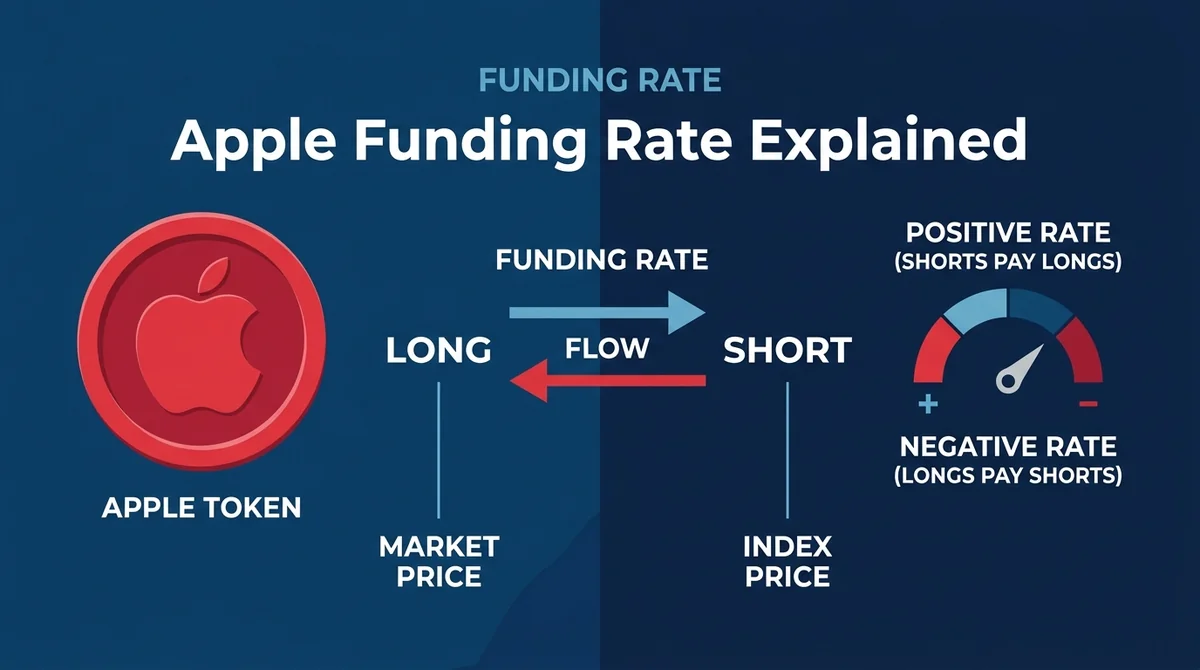
Apple funding rate is the funding rate on tokenized Apple stock perpetuals—a derivatives holding cost, not a real US stock fee. Mechanics and risks explained.
The Apple funding rate refers to the funding rate on tokenized Apple stock perpetual futures. It is a derivatives-level holding cost and has nothing to do with real US stock trading fees. Before understanding it, you first need to distinguish whether you hold price exposure or shareholder status.
#What Exactly Does the Apple Funding Rate Mean?
Conclusion: The "funding rate" here is not broker margin interest. It is the periodic funding rate settled on tokenized Apple stock perpetual futures.
#Is It a Real US Stock Fee or a Tokenized Perpetual Rate?
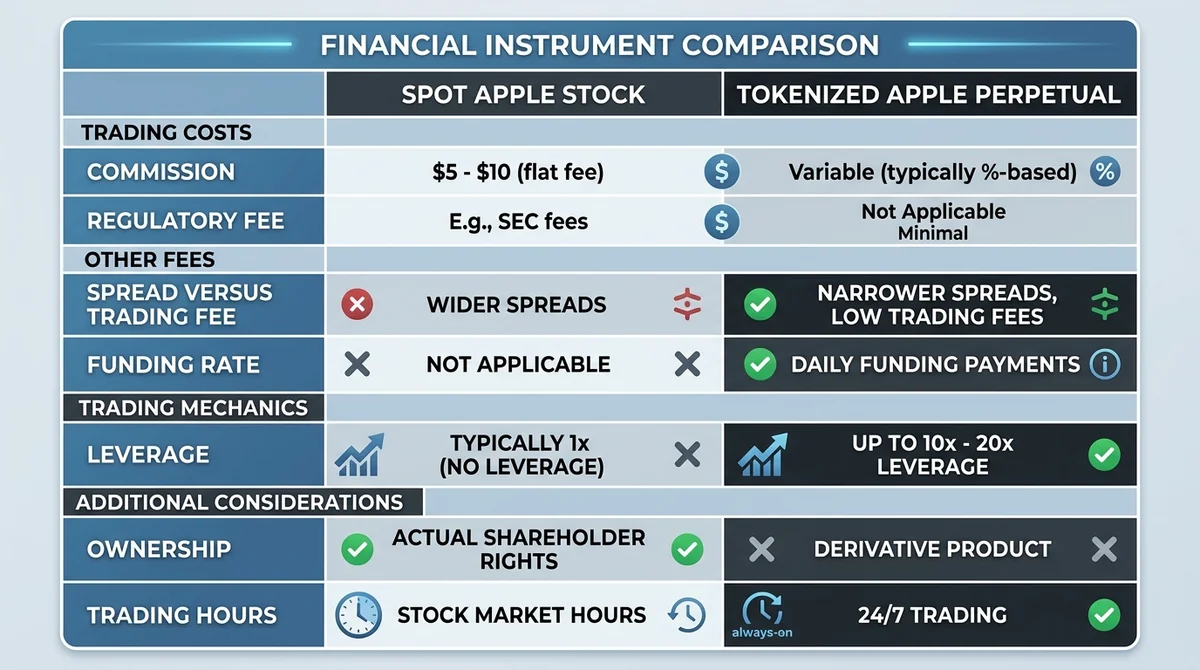
Answer: It is a tokenized perpetual rate. Real US stock trading involves commissions, regulatory fees, spreads, and so on—there is no such item as a "funding rate." The Apple funding rate only arises at the derivatives level of tokenized Apple stock perpetuals and operates as a periodic payment between longs and shorts.
#Why Do Tokenized Stock Perpetuals Have a Funding Rate?
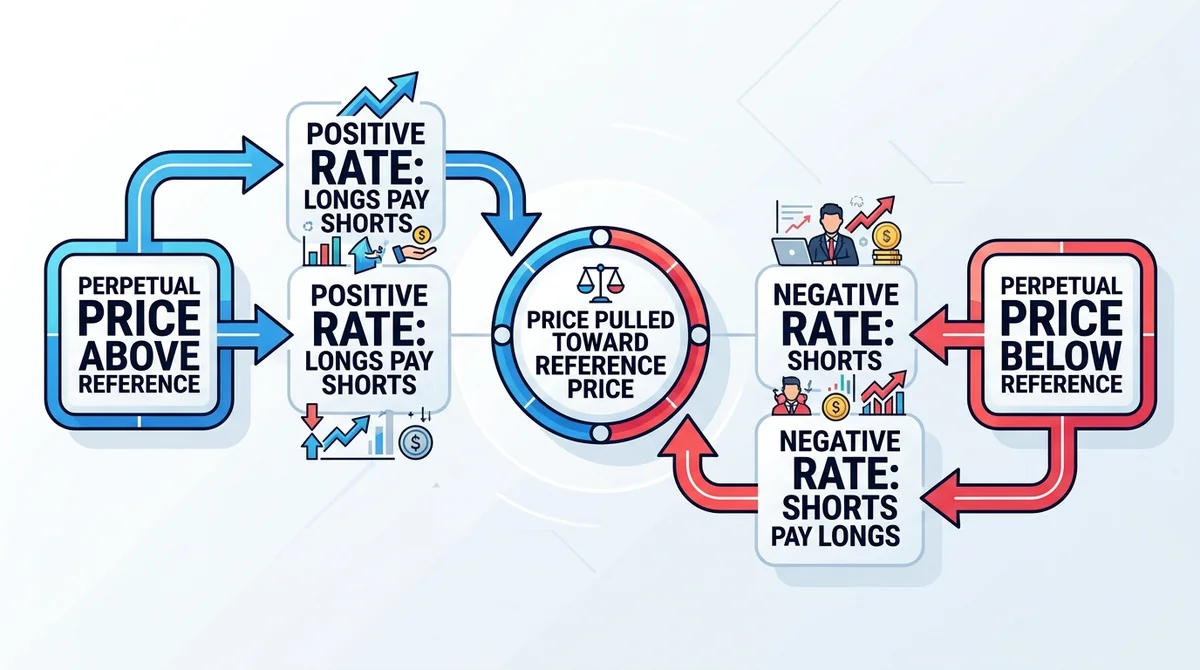
Mechanism: Perpetual contracts have no expiry date, so a mechanism is needed to keep the contract price from deviating from the reference price for extended periods. How does perpetual futures funding rate work is one such anchoring tool: when the perpetual price is above the reference price, longs typically pay shorts; when the perpetual price is below the reference price, the direction reverses. Its purpose is to pull the perpetual price back toward the reference price, not to predict price direction. The specific perpetual futures funding rate settlement schedule and rate caps/floors are determined by each platform's rules; this article has not verified them platform by platform.
#How Does It Differ from the Cost of Holding Apple Stock in Spot?
Difference: Holding the asset in spot means you own the asset itself, with costs mainly being trading fees and opportunity cost. A perpetual only trades price movements and does not hold the asset, so its costs include an additional ongoing funding rate. The two are not on the same level: spot is ownership exposure (whether tokenized stocks carry shareholder rights is a separate question), while perpetuals are price exposure plus perpetual futures leverage.
#How Is the Apple Funding Rate Determined?
Conclusion: The funding rate is driven by the deviation of the tokenized perpetual price from the reference price, and its positive or negative sign reflects the balance of long and short forces. However, the specific formula and parameters vary by platform.
#Why Does the Funding Rate Fluctuate Between Positive and Negative?
Mechanism: The rate is not a fixed value. When bullish sentiment is strong and the perpetual price is pushed above the reference price, the rate turns positive and longs pay. When short pressure is heavy and the perpetual price falls below the reference price, the rate turns negative and shorts pay. The absolute value of the rate usually reflects the degree of deviation, while the direction reflects who is paying. It should be noted that some platforms use a composite formula of "mark price + premium index + interest rate benchmark," so it is not determined solely by the price spread; this article has not verified each platform's parameters individually.
#US Stock Prices Are the Cause and Token Prices the Effect—How Does This Affect the Rate?
Transmission: The price of tokenized Apple stock is anchored to the real US stock price of Apple. The real US stock price is the cause and the token price is the effect. The token perpetual follows the US stock but is not identical, because the perpetual also incorporates long-short dynamics within the derivatives market. Therefore, the rate reflects supply-demand imbalances within the token perpetual market itself, not a direct reading of Apple's fundamentals. In addition, US stocks have limited trading hours; if token perpetuals trade 24/7, funding rate behavior during market closure may differ from behavior during market hours—a point that is often overlooked.
#Do Similar Underlyings (TSM, Nvidia, TSMC) Follow the Same Rate Logic?
Isomorphism: For tokenized perpetuals on underlyings such as TSM, Nvidia, TSMC, Google, Amazon, COIN, GOOGL, and the S&P 500, the rate mechanism follows the same logic in principle: deviation-driven, periodically settled, and switching between positive and negative. The differences lie in each underlying's liquidity, volatility characteristics, and platform parameter settings. The mechanism principles are similar, but that does not mean the values are similar. Specific rate values for particular underlyings should not be guessed when the data is not public.
#How Does the Apple Funding Rate Affect Holding Costs?
Conclusion: The funding rate is an ongoing settled holding cost or income. Its positive or negative direction determines whether longs or shorts pay, and combined with perpetual futures leverage, it amplifies the cost pressure of long-term holding.
#How Much Does It Cost to Hold Tokenized Apple Perpetuals Long-Term?
Cost Structure: The rate is settled periodically, so long-term holding means costs accumulate continuously. The exact cumulative amount depends on the rate value each period, the settlement cycle, and holding time. A precise figure cannot be given when single-value data is not public, but the directional judgment is: the longer you hold, the larger the absolute value of accumulated funding, and the direction may reverse midway.
#When the Rate Is Positive and Negative, Who Pays Whom?
Direction: A positive rate typically means longs pay shorts, and a negative rate typically means shorts pay longs. This means the rate can be either a cost or an income for holders, depending on which side you are on and the direction of the rate.
#How Do Risks Amplify When the Rate and Leverage Combine?
Amplification Mechanism: Perpetual futures leverage amplifies gains and losses, and combining the funding rate with leverage accelerates cost accumulation. Under high leverage, even if the price direction does not change, ongoing funding rates can erode margin and push you closer to liquidation. The rate itself does not constitute a directional judgment, but it is a hidden cost item for leveraged positions. Note also that beyond the funding rate there are trading fees, spreads, and slippage; total costs should be calculated together.
#What Common Misconceptions Arise When Looking at the Apple Funding Rate?
Conclusion: Treating tokenized perpetuals as real shareholdings, or judging direction solely by the level of the rate, are both common misconceptions.
#What Is Wrong with Treating Tokenized Perpetuals as Real Shareholdings?
Misconception: Tokenized stock perpetuals are derivatives and do not carry real shareholder rights. Tokenized stocks ≠ real US stocks; tokenized stock perpetuals = derivatives. Treating them as shareholdings leads to misjudging the attribution of dividends, voting rights, corporate actions, and other entitlements. As for whether tokenized stock spot itself carries economic rights, that depends on the issuance structure and must be based on the specific product terms.
#Why Is It Misleading to Look Only at the Rate and Not Price Direction?
Misconception: The rate is a cost item and does not constitute a directional judgment. A negative rate does not mean bullish, and a positive rate does not mean bearish; it only indicates who is paying between longs and shorts. Treating the rate as a directional signal is misreading a cost indicator as a price indicator.
#How Should Missing Rate Data Be Handled?
Handling: When specific rate values are not public, do not guess. Mark them as data not disclosed and return to the mechanism level to understand the cost structure. If actual values are needed, refer to the trading platform's official funding rate page.
#Risk Warning and Disclaimer
Risk: Tokenized stock perpetuals carry perpetual futures leverage and may lead to liquidation; funding rates continuously generate costs; tokenized stocks differ from real US stocks in entitlement attributes; tokenized products also involve issuer credit, custody fee, and regulatory applicability risks. This article only explains mechanisms and does not predict prices or recommend buying or selling.
This content is compiled from public information and mechanism principles and does not constitute investment or open account advice. Specific rate values are not given in this article because the relevant data is not public in verifiable sources; actual conditions may change. To check the latest rates and product rules, please refer to the relevant platform's official sources.
FAQ
Is the Apple funding rate broker margin interest?
No. It refers to the funding rate on tokenized Apple stock perpetual contracts, a periodic settlement cost at the derivatives level, and is not the same concept as margin interest from a real US stock broker.
Who pays when the funding rate is positive?
A positive rate typically means longs pay shorts, and a negative rate reverses the direction. The rate direction reflects the balance of long and short forces and does not constitute a price direction judgment.
Can you receive Apple dividends from tokenized Apple stock perpetuals?
No. Tokenized stock perpetuals are derivatives that provide only price exposure and do not carry real shareholder rights. Entitlements such as dividends differ from direct shareholding.
Is the rate logic for TSM, Nvidia, and TSMC the same as for Apple?
The principle is isomorphic: all are driven by the deviation of the perpetual price from the reference price, settled periodically, and switch between positive and negative. Differences lie in each underlying's liquidity, volatility characteristics, and platform parameters. Specific values should not be guessed when the data is not public.
Can the level of the rate be used to judge price direction?
No. The rate is a cost item that reflects who is paying between longs and shorts and does not constitute a directional signal. Treating it as a directional indicator is a common misreading.
Related Terms
Read the review? Ready to try a small position?
The crypto assets and tokenized US stocks/ETFs covered here are available on MSX — spot and perpetuals.
Quick Start Trading →New here? Registration takes three quick steps.