Real Estate RWA
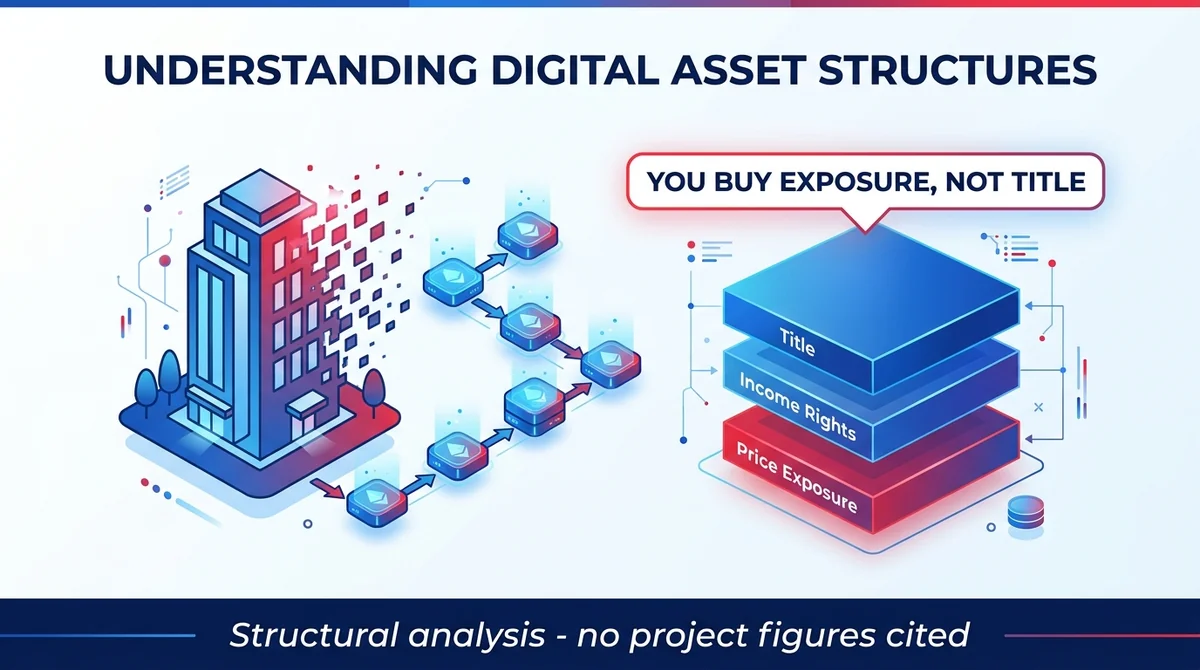
Real estate RWA tokenizes property income rights or price exposure—holding tokens is not ownership. Spot vs perpetual, REITs comparison, key risks and a checklist.
The core judgment for real estate RWA is this: what you buy is tokenized rights or price exposure, not property title. So first confirm whether the token is spot-type or perpetual-type, then decide whether it is worth deeper research. This article proceeds through five layers: definition, types, who it suits, risks, and evaluation method. It is a structural analysis throughout and cites no specific project's scale, yield, or valuation figures; where specific projects are involved, always defer to the project's official disclosures, and mark anything undisclosed as "data not public."
#What exactly is real estate RWA? How does it differ from buying property directly?
Real estate RWA is a product that turns property-related income rights, debt claims, or price exposure into on-chain tokens. What users hold is a token, and the token price theoretically tracks the value of the underlying property; underlying property value is the cause and token price is the effect—they are not the same thing.
#Does a real estate RWA token represent title or income rights?
In most structures, the token represents income rights or fractionalized equity, not title registered under an individual's name. This is a structural generalization (an inference); for any single project it still needs verification. Title registration, mortgage priority, and SPV (special purpose vehicle) arrangements are legal-layer information that must be verified project by project; if the project does not disclose ownership structure and custodian, treat it as insufficient information.
#What is the relationship between token price and underlying property value?
Theoretically the token price is anchored to the underlying property's valuation or cash flow, but the actual price is set by secondary-market supply and demand and may diverge. The size of the divergence depends on liquidity depth, whether the redemption mechanism runs smoothly, and how often valuation is updated. How often valuation is updated and who performs it are items that must be checked.
#How does it differ from REITs and buying property directly?
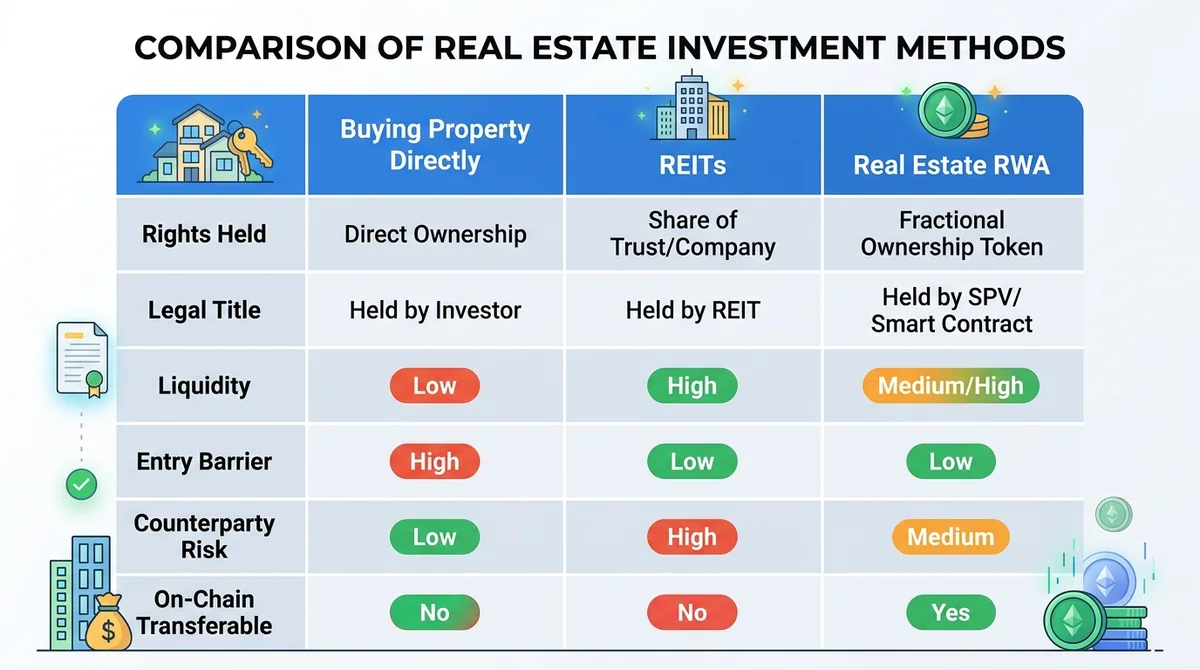
- Buying property directly: you obtain title, bear all price fluctuation and maintenance costs, and face long transaction cycles, high entry barriers, and low liquidity.
- REITs: you hold fund units, usually with a regulatory framework, distribution mechanism, and secondary-market liquidity, but without title.
- Real estate RWA: fractionalized and transferable on-chain, usually with a lower threshold, but legal ownership, custody, and redemption arrangements vary widely, and platform and on-chain risks are layered on top.
What all three share is exposure to property value fluctuation; what differs is the rights layer, the source of liquidity, and counterparty risk.
#What types of real estate RWA are there? How do you tell spot from perpetual?
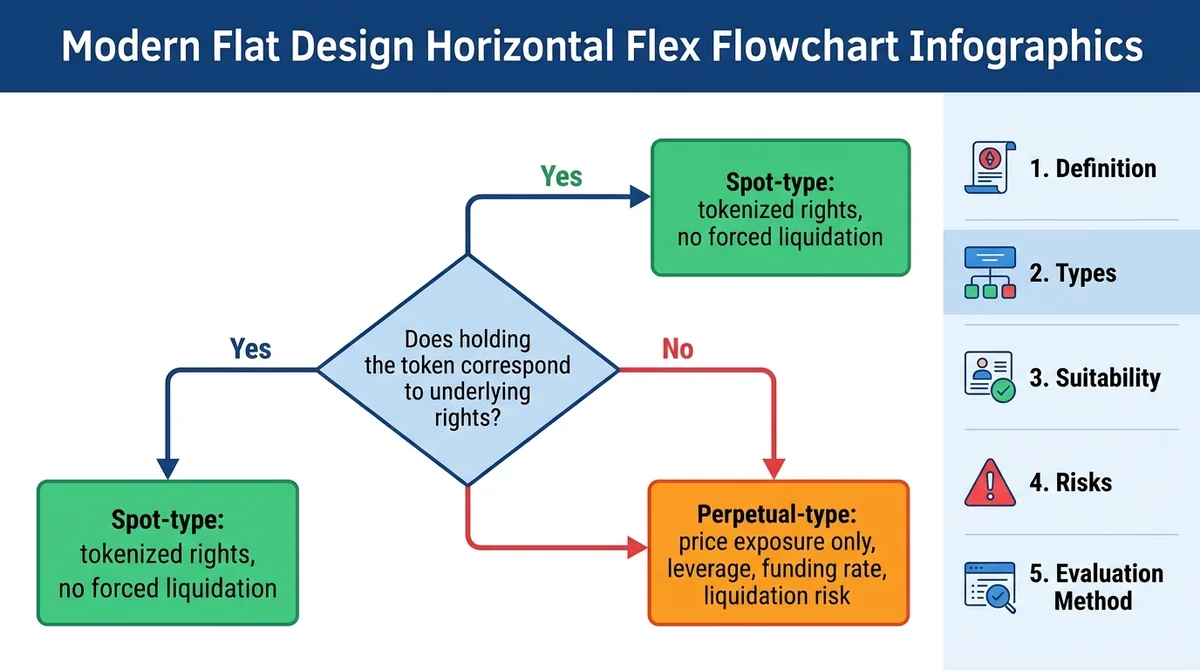
There is only one way to distinguish them: whether holding the token corresponds to underlying rights. If it does, it is spot-type; if you are only trading price movement, it is perpetual-type. Spot-type is closer to real property; perpetual-type is a derivative with a higher risk tier.
#How do tokenized property spot and tokenized property perpetuals differ?
- Spot-type: real buying and selling; you hold tokenized rights, the price moves with the underlying asset and market supply and demand, and there is no forced liquidation mechanism (unless the platform has other rules).
- Perpetual-type: you only trade price movement, with perpetual futures leverage, you pay how does perpetual futures funding rate work, and adverse price moves can trigger liquidation or a blow-up. Holding a perpetual does not mean holding "ownership" of property exposure—it means holding a derivative contract.
This distinction follows the same logic as "perpetual futures vs spot trading pros and cons" in crypto markets; see the framework in our Spot vs Perpetual: 2026 Trader Strategy and Platform Selection Decision Guide.
#What are income-rights, debt-claim, and fund-unit types?
- Income-rights type: the token corresponds to the right to distributions from cash flow generated by the underlying property; distribution rules and frequency depend on project terms.
- Debt-claim type: the token corresponds to a loan or mortgage claim; returns come from interest, and risk comes from borrower default and collateral disposal.
- Fund-unit type: the token corresponds to fund or SPV units, structurally close to an on-chain version of REITs, and dependent on the manager's ability.
The risk ranking among the three cannot be generalized; it depends on collateral ratio, seniority, and disposal terms. When specific parameters are not public, safety should not be assumed.
#What risk tier does each type correspond to?
Looking at "distance from the underlying asset": direct title < fund units/income rights < debt claims < perpetual derivatives. The greater the distance, the more counterparty and mechanism risks are layered on. Perpetual-type, because it carries perpetual futures leverage, sits in the highest risk tier. This ranking is a structural judgment (an opinion), not a rating of any specific project.
#Who should pay attention to real estate RWA, and who should avoid it?
It suits users who want small-ticket property exposure and need liquidity; users seeking real title and stable rent should avoid it.
#How should people with limited capital who want property exposure judge?
Confirm three things first: whether the token is spot or perpetual, the minimum participation unit, and the exit path (secondary-market depth or redemption window). If exit depends only on project-side redemption with no clear timeframe, the liquidity assumption does not hold.
#Is it suitable for people who need liquidity but do not want to sell their home?
That need corresponds to "unlocking existing property," but real estate RWA tokenizes assets held by the project, not an individual's property. On-chain mortgaging or fractionalization of personal property is a different structure and requires separate verification of compliance and ownership arrangements.
#Why is it unsuitable for people seeking stable rent and real title?
Because token holders are usually not the registered title holder, cash flow distribution is constrained by project terms, and token price volatility may far exceed rental yield. If the goal is stable cash flow, REITs or direct property ownership are more direct at the rights layer.
#Scenario routing
- If you are a small-capital user who wants property-related exposure and can tolerate price volatility → prioritize spot-type, and check underlying asset disclosure and redemption mechanisms.
- If you are looking to trade price movement and are familiar with leverage and funding rates → you can study perpetual-type, but must first understand liquidation rules.
- If you are seeking real title and registered rights → real estate RWA does not match; look at direct purchases or title-based instruments.
- If you are seeking stable dividends → compare the distribution terms of REITs and income-rights RWA, focusing on distribution frequency and seniority.
- If you are unable to tolerate large swings in principal → do not participate in any leveraged tokenized property product.
#What are the main risks of real estate RWA?
The main risks cluster in four places: opaque valuation, price decoupling, insufficient liquidity, and leveraged blow-ups.
#Why do underlying property valuation and token price decouple?
Property valuation relies on appraisal reports and updates infrequently; token prices trade in real time and reflect market sentiment and liquidity premiums. When the redemption mechanism is not smooth, there is no arbitrage force between the two, and divergence can persist or even widen.
#What uncertainties exist in liquidity and exit mechanisms?
When secondary-market depth is insufficient, large sells may significantly depress the price; redemption windows may have lock-up periods, minimum redemption amounts, or queuing mechanisms. If these terms are not public, they should be treated as unreliable.
#Why can perpetual-type products blow up?
Perpetuals carry leverage; adverse price moves erode margin, and when the maintenance margin level is hit, liquidation is triggered. In addition, how does perpetual futures funding rate work continuously consumes holding costs, and when the direction is wrong over a long hold, costs stack up.
#Legal ownership and custody arrangements must be verified yourself
The path for token holders to assert rights, who custodies the underlying assets, whether the SPV is independent, and whether bankruptcy isolation holds are all items that must be verified. When this information is missing, yield figures have no reference value.
#How do you evaluate a real estate RWA project?
The method is to check a checklist item by item and score it, not to judge by yield level.
#What public information should you look at?
- Underlying asset disclosure: specific property location, type, valuation report, and update date.
- Ownership structure: SPV setup and the specific rights the token corresponds to (income rights/debt claims/units).
- Custodian: who custodies the assets and the tokens respectively, and whether there is third-party audit.
- Token type: spot or perpetual, and whether it carries leverage.
- Liquidity arrangements: secondary-market depth, redemption window, lock-up period.
- Fee structure: management fee, redemption fee, funding rate (perpetual).
- Distribution mechanism: how cash flow is calculated, when it is distributed, and how seniority works.
#Which missing data points mean you should walk away?
If any of the three—ownership structure, custodian, or redemption terms—is missing, counterparty risk cannot be assessed, and you should stay cautious or walk away. If the valuation report is missing, you cannot judge how far the token price deviates from underlying value.
#How do you use comparison dimensions to decide?
Turn the dimensions above into a table, score item by item, then compare horizontally against alternatives (REITs, direct-equity tokenized products). For our multi-asset comparison method, see MSX Compare In-Depth Review 2026; its dimensional framework also applies to the RWA category.
#Action checklist
- Confirm whether the token is spot-type or perpetual-type.
- Find the specific disclosure documents and valuation date for the underlying asset.
- Verify the ownership structure (SPV/custody/bankruptcy isolation).
- Check the redemption window, lock-up period, and minimum redemption amount.
- Calculate all fees (management fee + redemption fee + funding rate).
- Assess whether secondary-market depth supports your position size.
- Compare against alternatives such as REITs on the same dimensions before deciding.
#FAQ
Q1: Does a real estate RWA token equal buying a home? No. Tokens usually represent income rights or fractionalized equity, not registered title, and price movement may decouple from underlying property valuation.
Q2: Which is lower risk, spot-type or perpetual-type? Structurally, spot-type is closer to the underlying asset and has no leveraged liquidation mechanism; perpetual-type carries leverage and funding rates and sits in a higher risk tier. The specifics still depend on project terms.
Q3: How do you choose between real estate RWA and REITs? REITs usually sit under mature regulatory frameworks with clear distribution mechanisms; real estate RWA is more flexible in fractionalization and on-chain transfer, but ownership and custody arrangements vary widely and must be verified item by item.
Q4: Can you participate in a project that does not disclose its underlying assets? You cannot assess valuation divergence or counterparty risk, so caution is advised. When key data is missing, mark it as "data not public" and treat it as insufficient information.
Q5: Why can perpetual-type products blow up? Leverage amplifies price moves, and hitting the maintenance margin triggers liquidation; at the same time, funding rates continuously consume holding costs.
This content is a structural analysis compiled from public information. It does not constitute investment or open account advice, and it contains no specific project's scale, yield, or valuation figures. Actual conditions may change; for verification of specific project terms, defer to the project's official sources and disclosure documents.
FAQ
Does a real estate RWA token equal buying a home?
No. Tokens usually represent income rights or fractionalized equity, not registered title, and price movement may decouple from underlying property valuation.
Which is lower risk, spot-type or perpetual-type?
Structurally, spot-type is closer to the underlying asset and has no leveraged liquidation mechanism; perpetual-type carries leverage and funding rates and sits in a higher risk tier. The specifics still depend on project terms.
How do you choose between real estate RWA and REITs?
REITs usually sit under mature regulatory frameworks with clear distribution mechanisms; real estate RWA is more flexible in fractionalization and on-chain transfer, but ownership and custody arrangements vary widely and must be verified item by item.
Can you participate in a project that does not disclose its underlying assets?
You cannot assess valuation divergence or counterparty risk, so caution is advised. When key data is missing, mark it as "data not public" and treat it as insufficient information.
Why can perpetual-type products blow up?
Leverage amplifies price moves, and hitting the maintenance margin triggers liquidation; at the same time, funding rates continuously consume holding costs.
Related Terms
Read the review? Ready to try a small position?
The crypto assets and tokenized US stocks/ETFs covered here are available on MSX — spot and perpetuals.
Quick Start Trading →New here? Registration takes three quick steps.