RWA Perpetuals
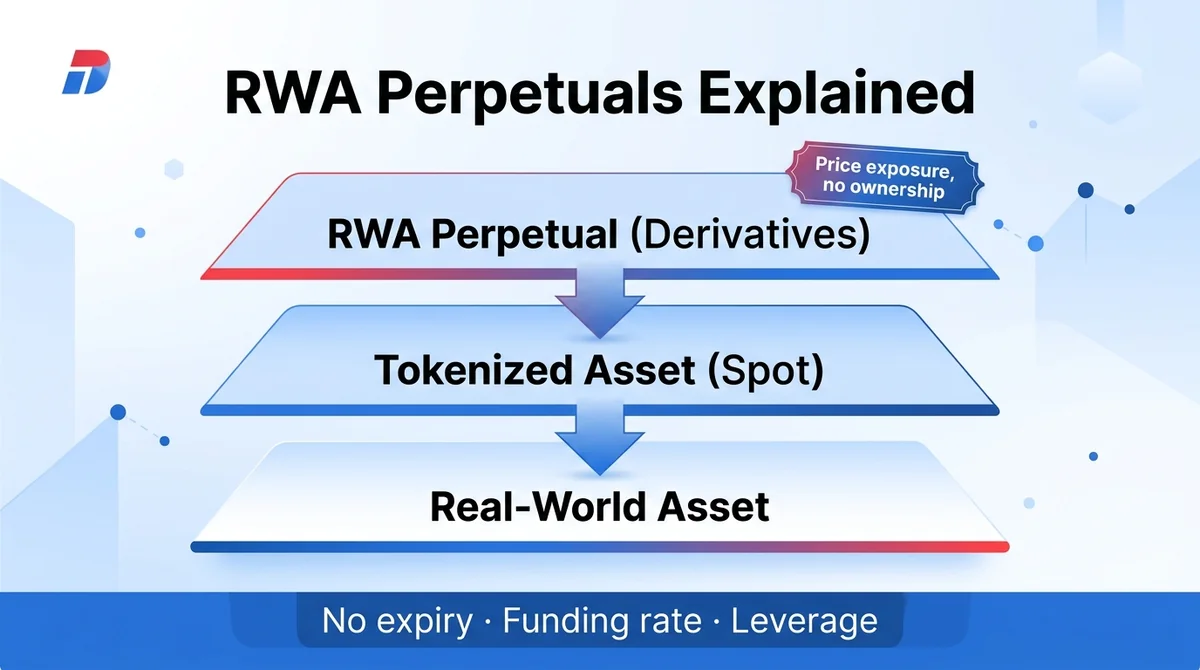
RWA perpetuals track tokenized real-asset prices and trade price exposure, not the asset. How they differ from RWA spot, funding rates, leverage risk, and who they fit.
RWA perpetuals are perpetual contracts whose underlying is the price of tokenized real-world assets. They are derivatives: they trade only on price movements and do not hold the asset itself. Users who want long-term exposure to real assets should choose RWA spot vs perpetual (tokenized assets); only users seeking two-way long/short exposure and capital efficiency through perpetual futures leverage, and who can withstand liquidation risk, should consider RWA perpetuals.
#What Are RWA Perpetuals? How Do They Differ From Spot and Standard Perpetuals?
Core definition: An RWA perpetual (tokenized RWA perpetual) is a perpetual contract whose underlying is the price of tokenized real-world assets. It has no expiry date, uses how does perpetual futures funding rate work to anchor the contract price to the underlying spot price, and supports perpetual futures leverage.
#Is the Underlying of an RWA Perpetual the Asset Itself or Price Exposure?
Conclusion: The underlying is price exposure, not the asset itself.
Perpetual contracts do not involve delivery or transfer of ownership of the underlying asset; traders hold a contract position settled by price. The tokenized asset price is the effect, and the underlying real asset price is the cause: the contract tracks the market quote of the tokenized asset, which in turn anchors to the price of the underlying real asset (stocks, gold, bonds, etc.). RWA perpetuals are therefore one layer further from the real asset than spot.
#How Do the Mechanics Compare With Standard Crypto Perpetuals?
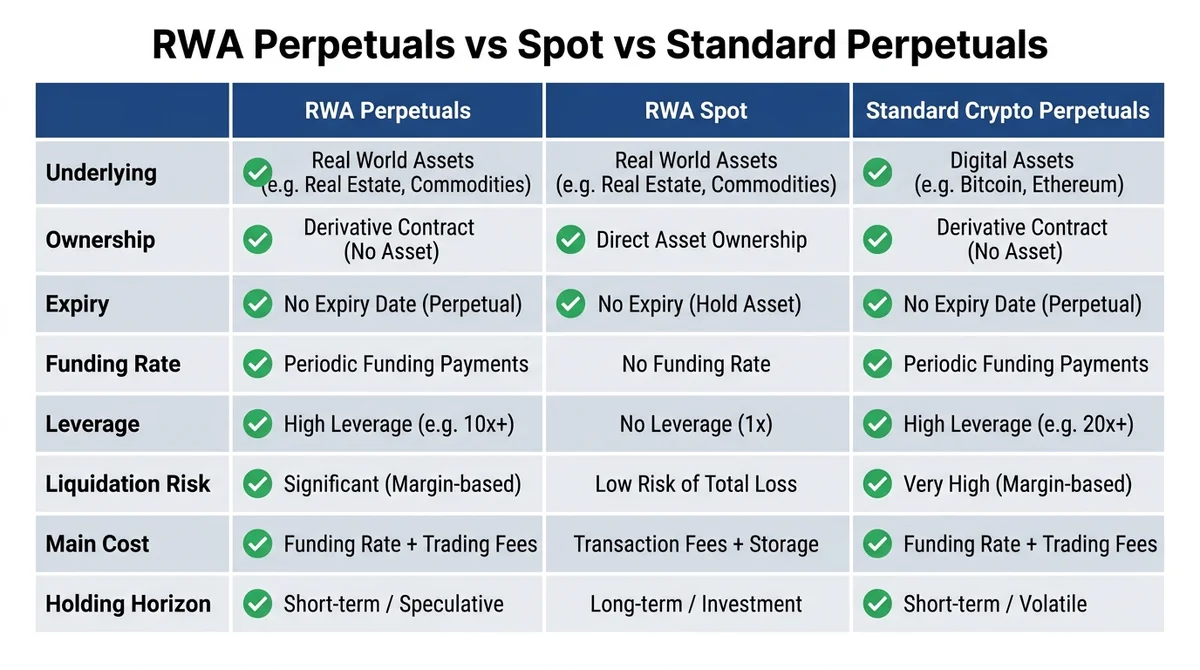
Similarities: No expiry, periodic funding rate settlement, margin and leverage, and liquidation mechanisms.
Differences: The underlying attributes differ. Standard crypto perpetuals have crypto assets themselves as the underlying, with prices formed continuously on on-chain markets; RWA perpetuals anchor to off-chain real assets, so the price transmission chain is longer and involves tokenization structures, custody fee arrangements, and underlying liquidity. This means RWA perpetuals may show more pronounced price deviations and slippage in extreme markets, and the anchoring efficiency of the funding rate is constrained by the spot liquidity of the underlying.
#How Do They Differ From RWA Spot (Tokenized Assets)?
Ownership: Spot involves real buying and selling, holding the tokenized asset itself; perpetuals do not hold the asset.
Risk structure: Spot risk is mainly underlying asset price volatility, tokenization structure, and custody risk; perpetuals add leveraged amplification, ongoing funding rate costs, and forced liquidation risk on top.
Cost structure: Spot mainly involves one-off trading fees and custody/structure costs during holding; perpetuals involve trading fees plus continuously paid funding rates.
Holding horizon: Spot suits medium- to long-term exposure; perpetuals suit short- to medium-term directional trading and hedging.
#How Do RWA Perpetuals Differ From Tokenized Stock Perpetuals?
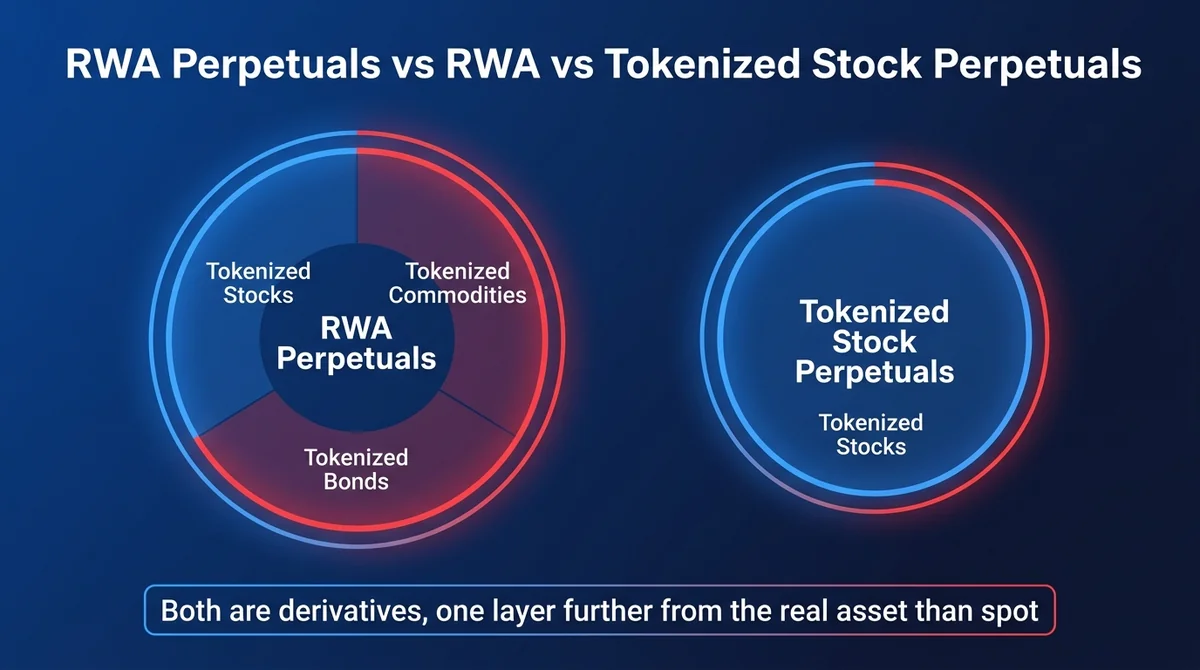
In one sentence: Both are derivatives; the difference is underlying coverage—RWA perpetuals cover broader tokenized real assets, while tokenized stock perpetuals focus on tokenized stocks. Both are further from the real asset than spot.
#Where Do the Underlying Asset Types Differ?
RWA perpetuals have a broader underlying scope, theoretically covering tokenized stocks, tokenized commodities, tokenized bond and other real assets; tokenized stock perpetuals narrow the underlying to tokenized stocks. The broader the underlying, the greater the differences in liquidity and pricing efficiency across contracts.
#Is the Distance From the Real Asset the Same?
No, but both sit at the derivatives layer. The chain for tokenized stock perpetuals is: real stock price → tokenized stock quote → perpetual contract price. The chain for non-stock underlyings in RWA perpetuals is similar, but trading hours, liquidity depth, and price discovery mechanisms of the underlying assets differ more, so deviation risk varies by underlying.
#How Do the Risk Sources Differ?
Shared risks: perpetual futures leverage, funding rates, liquidation, and underlying liquidity.
Differing risks: Tokenized stock perpetuals concentrate risk on stock market session effects and corporate actions (such as dividends and splits) affecting contract pricing; broad RWA perpetuals must additionally account for differences in liquidity and pricing conventions across asset classes (gold, bonds).
#How Do RWA Perpetuals Work?
#How Does the Funding Rate Pull the Contract Price Back to the Underlying Spot?
Mechanism: The funding rate is a periodic settlement between longs and shorts. When the contract price is above the underlying spot price, longs pay shorts; otherwise, shorts pay longs. The ongoing cost prompts the deviating side to reduce positions, pulling the contract price back toward the underlying spot.
Implication: The funding rate is an ongoing cost of holding a position, and holding a one-sided position long term will be continuously eroded. The rate level itself is also a signal of market sentiment and leverage crowding.
#How Do Leverage and Margin Work in RWA Perpetuals?
Mechanism: Traders post margin to open a notional position several times the margin. perpetual futures leverage amplifies both gains and losses; when losses erode margin below the maintenance margin level, liquidation is triggered, and in extreme cases a total loss of margin occurs.
Implication: The higher the leverage multiple, the smaller the adverse move the position can absorb. The volatility characteristics of RWA perpetual underlyings differ from crypto assets, so perpetual futures leverage settings must match the actual volatility of the underlying.
#How Does Underlying Liquidity Transmit to the Contract?
Transmission path: Insufficient spot liquidity in the tokenized asset → wider quote spreads and thinner depth → lower contract anchoring efficiency → larger contract price deviations and higher slippage → liquidation price more easily reached.
Implication: Evaluating RWA perpetuals requires looking not only at contract market depth but also at the liquidity of the tokenized asset itself.
#Who Should Consider RWA Perpetuals, and Who Should Avoid Them?
Conclusion: Users who want long-term exposure to real assets should choose spot or tokenized assets news; only users seeking two-way long/short exposure, capital efficiency through perpetual futures leverage, and who can withstand liquidation risk should consider RWA perpetuals.
#What Should Long-Term Holders of Real-Asset Exposure Choose?
Choose RWA spot vs perpetual (tokenized assets). Spot has no ongoing funding rate cost, involves no forced liquidation, and holds the asset itself. If the goal is to capture dividends, corporate actions, and other ownership attributes, pay closer attention to the structural arrangements at the spot layer.
#What About Users Who Only Want to Go Long or Short and Can Withstand Liquidation?
They may consider RWA perpetuals, but must be clear on three points: first, the funding rate is an ongoing cost that erodes more the longer the position is held; second, the perpetual futures leverage multiple should match the underlying's volatility; third, underlying spot liquidity determines the contract's deviation and slippage risk.
#How Should Risk Tolerance Be Assessed?
Three dimensions:
- Holding period: For intraday to several-week directional trades, perpetuals are more efficient; for exposures of several months or more, spot is more suitable.
- Risk appetite: Whether you can accept total loss of margin.
- Cost sensitivity: Whether you can bear ongoing funding rate expenses.
Scenario routing:
- If you are a long-term allocation user whose goal is holding real-asset exposure, choose RWA spot vs perpetual.
- If you need to hedge spot positions, you can use RWA perpetuals to short as a hedge, but must calculate the funding rate cost.
- If you are a short- to medium-term directional trader who can withstand liquidation, you may consider RWA perpetuals and strictly control perpetual futures leverage.
- If you are focused on stock exposure, first distinguish tokenized stock spot from tokenized stock perpetuals.
- If you are new to derivatives, first understand margin and liquidation mechanisms before considering participation.
#What Risks Should You Watch for in RWA Perpetuals?
Conclusion: RWA perpetual risks come from forced liquidation caused by leveraged amplification of gains and losses, ongoing funding rate costs, and additional uncertainty from tokenization structures and underlying liquidity.
#Why Is Leverage Dangerous?
perpetual futures leverage amplifies gains and losses proportionally. For example: at 10x leverage, an adverse move of about 10% in the underlying can wipe out the entire margin (excluding fees and funding rates). The higher the leverage, the smaller the margin for error, and liquidation is executed automatically, leaving no time to react.
#How Do Forced Liquidation and Total Loss Occur?
When account equity falls below the maintenance margin requirement, the system forcibly closes the position; if market liquidity is insufficient or prices gap, the close may not execute at the expected price, causing losses to exceed the initial margin—a total loss. When the underlying liquidity of RWA perpetuals is thin, this risk is amplified.
#What Additional Uncertainty Does the Tokenization Structure Itself Bring?
These include: issuance and redemption mechanisms of tokenized assets, custody arrangements, ownership attribution of underlying assets, and compliance differences across jurisdictions. These factors are not directly reflected in the contract price but affect the pricing and liquidity of the underlying spot, which then transmits to the contract.
#Risk Warning and Disclaimer
This article explains mechanics and scenarios only and contains no price forecasts or stock recommendations. Specific rules, fees, and underlyings are subject to the official disclosures of the relevant platforms. Derivatives trading may result in loss of all margin; please assess risks yourself. To verify specific terms, refer to the official sources of the relevant platforms.
This content is compiled from public information and does not constitute investment or open account advice. The mechanics described are general explanations and do not refer to specific parameters of any platform; actual conditions may change.
FAQ
What is the core difference between RWA perpetuals and RWA spot?
RWA spot involves real buying and selling, holding the tokenized asset itself; RWA perpetuals are derivatives that trade only on price movements, do not hold the asset, and add perpetual futures leverage, funding rate, and liquidation risk.
Are the mechanics of RWA perpetuals the same as standard crypto perpetuals?
The mechanics framework is the same: no expiry, funding rate anchoring, margin and leverage, and liquidation. The difference is the underlying: RWA perpetuals anchor to tokenized quotes of off-chain real assets, so the price transmission chain is longer and more constrained by the underlying's spot liquidity.
What is the difference between RWA perpetuals and tokenized stock perpetuals?
Both are derivatives; the difference is underlying coverage. RWA perpetuals cover broader tokenized real assets (stocks, gold, bonds, etc.), while tokenized stock perpetuals focus on tokenized stocks.
For long-term real-asset exposure, should I choose spot or perpetuals?
Choose spot or tokenized assets. The funding rate on perpetuals is an ongoing cost that erodes more the longer the position is held, and there is forced liquidation risk, so perpetuals are not suitable as a long-term holding tool.
Is the RWA perpetual funding rate a gain or a cost?
It depends on direction and market conditions. When the contract price is above spot, longs pay and shorts receive; the reverse applies otherwise. For a position holder, the funding rate may be an ongoing cost or an ongoing gain, and must be judged by the actual direction.
Related Terms
Read the review? Ready to try a small position?
The crypto assets and tokenized US stocks/ETFs covered here are available on MSX — spot and perpetuals.
Quick Start Trading →New here? Registration takes three quick steps.