Synthetic Assets
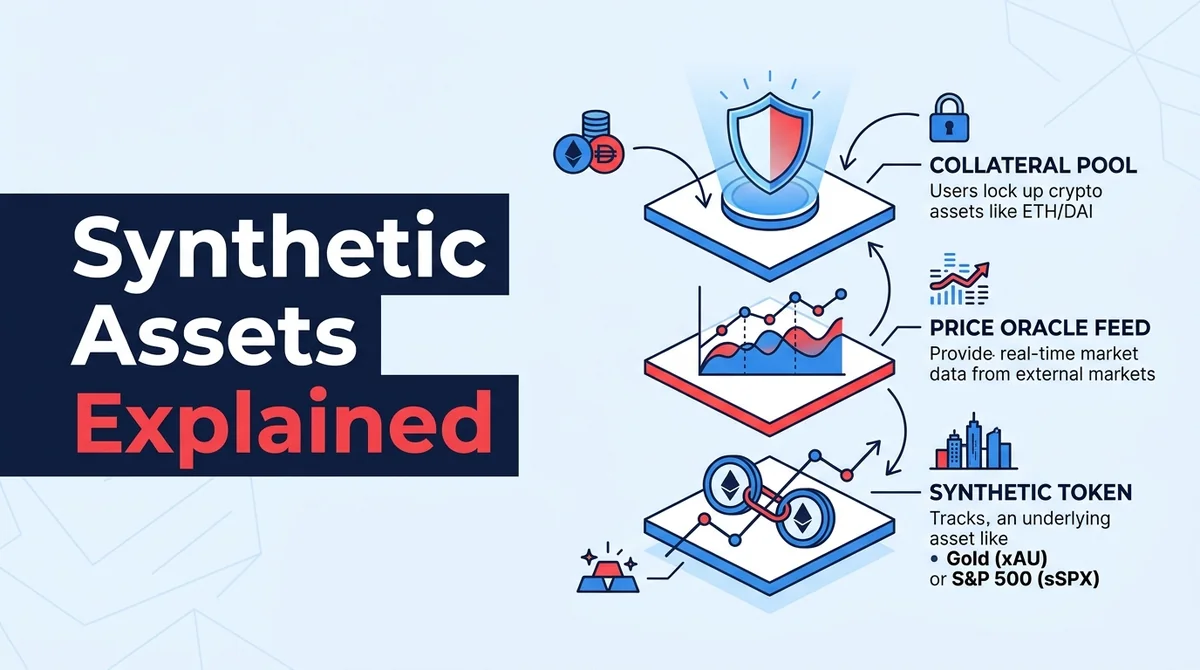
Synthetic assets track prices via collateral and oracles, giving exposure not ownership. Compare them with spot, tokenized assets news and perps.
Bottom line: Synthetic assets are derivative-style price exposure tools, not real asset ownership — check the rights profile and liquidation mechanics first, then decide between synthetic assets, spot, tokenized assets news, or perpetual futures.
#What exactly are synthetic assets? How do they differ from actually holding an asset?
Synthetic assets are derivative instruments that track the price movements of an underlying asset through collateral mechanisms and price oracles. What they give holders is price exposure, not true ownership of the underlying asset.
Synthetic assets provide price exposure rather than ownership; users who want shareholder rights should choose spot. Their price peg comes from a collateral-backed issuance and redemption mechanism plus oracle price feeds. The mechanism itself does not transfer the underlying asset, so the rights profile differs from spot.
#How do synthetic assets track the underlying asset's price?
Price tracking relies on two links: first, a collateral-backed issuance and redemption mechanism; second, price oracles feeding the underlying asset's market quotes into the contract. The contract adjusts minting, redemption, and liquidation conditions based on the feed, pushing the synthetic asset's price toward the underlying. This is mechanistic price anchoring, not a transfer of the asset itself.
#Does holding a synthetic asset equal holding the real asset?
No. Holding a synthetic asset does not create ownership of the underlying asset and typically carries no shareholder status, voting rights, or corporate-action entitlements tied to the underlying. It is closer to a contract exposure referenced to the underlying's price. If the goal is genuine ownership attributes, synthetic assets do not match on that basis.
#What is the difference between synthetic assets and tokenized assets?
Tokenized assets news are usually backed by real assets held by an issuer and emphasize a correspondence with the underlying; synthetic assets rely on collateral and oracles to replicate exposure at the price level and do not necessarily hold the underlying. The two differ in rights profile, counterparty structure, and risk sources, and should not be treated as equivalent.
#How do synthetic assets, spot, tokenized assets, and perpetual futures compare?
The core differences among these four tools lie in rights profile and risk sources, not in price direction. The table below compares them across five dimensions — rights profile, counterparty, liquidation mechanics, cost structure, and use case — so you can locate the right category directly.
| Dimension | Synthetic assets | Spot | Tokenized assets | Perpetual futures |
|---|---|---|---|---|
| Rights profile | Price exposure only, no ownership | Full ownership | Usually corresponds to real assets | Price exposure only, no ownership |
| Counterparty structure | Collateral pool and issuer | No issuer counterparty | Issuer and custody provider | Exchange and clearing house |
| Liquidation mechanics | Triggered when collateral ratio breaches threshold | No forced liquidation | Generally no forced liquidation | Forced liquidation when margin is insufficient |
| Cost structure | Trading fees, how does perpetual futures funding rate work, liquidation penalties | Trading fees and holding costs | Trading fees and management fees | Trading fees and how does perpetual futures funding rate work |
| Use case | Needs price exposure and can bear liquidation risk | Needs ownership and long-term holding | Needs real-asset exposure | Needs perpetual futures leverage and two-way trading |
Key difference in one line: for ownership, choose spot or tokenized assets news; for price exposure with acceptance of liquidation mechanics, consider synthetic assets and perpetual futures; the difference between synthetic assets and perpetual futures is the anchoring method — the former relies on collateral and issuance/redemption, the latter on the funding rate.
#What are the core mechanics and costs of synthetic assets?
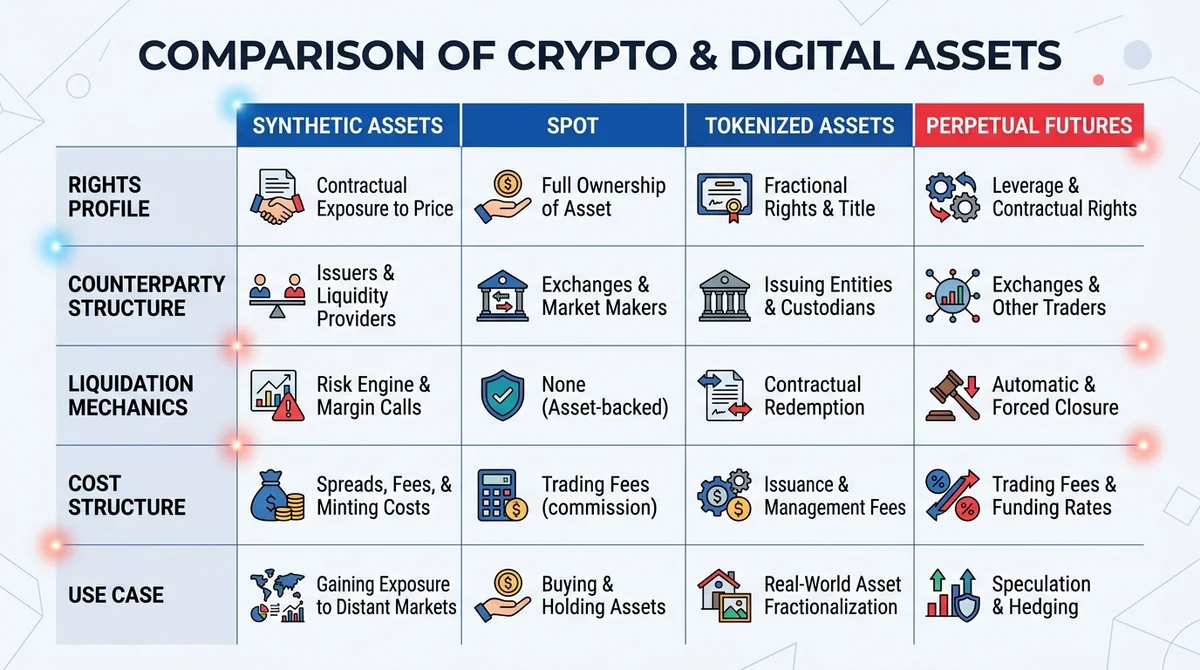
Synthetic assets run on collateral mechanisms and price oracles. Holding costs typically include trading fees, how does perpetual futures funding rate work (in some perpetual-style structures), and potential liquidation costs.
#How does the collateral mechanism support synthetic assets?
Common mechanisms fall into two types: overcollateralization and algorithmic collateral. Overcollateralization requires collateral value to exceed the synthetic asset exposure to absorb price volatility; algorithmic mechanisms adjust supply and incentives through parameters to maintain the peg. Collateral adequacy directly determines the system's solvency and liquidation triggers. Specific collateral ratio ranges and liquidation thresholds vary by platform and are not assumed here; such parameters should be treated as undisclosed data.
#What role do price oracles play in synthetic assets?
Oracles are the price input source for synthetic assets. Feed frequency, data sources, and latency directly affect the execution of minting, redemption, and liquidation. If an oracle lags or deviates, contracts may execute at the wrong price, creating a gap versus the real market price.
#What costs arise from holding synthetic assets?
Costs fall into three main categories: trading fees, how does perpetual futures funding rate work (charged periodically in some perpetual-style structures), and penalties and slippage incurred when liquidation occurs. Specific fee levels vary by platform and product structure and are not assumed here; where a platform has not disclosed fee data, it should be treated as undisclosed rather than zero-cost.
#What are the main risks of synthetic assets?
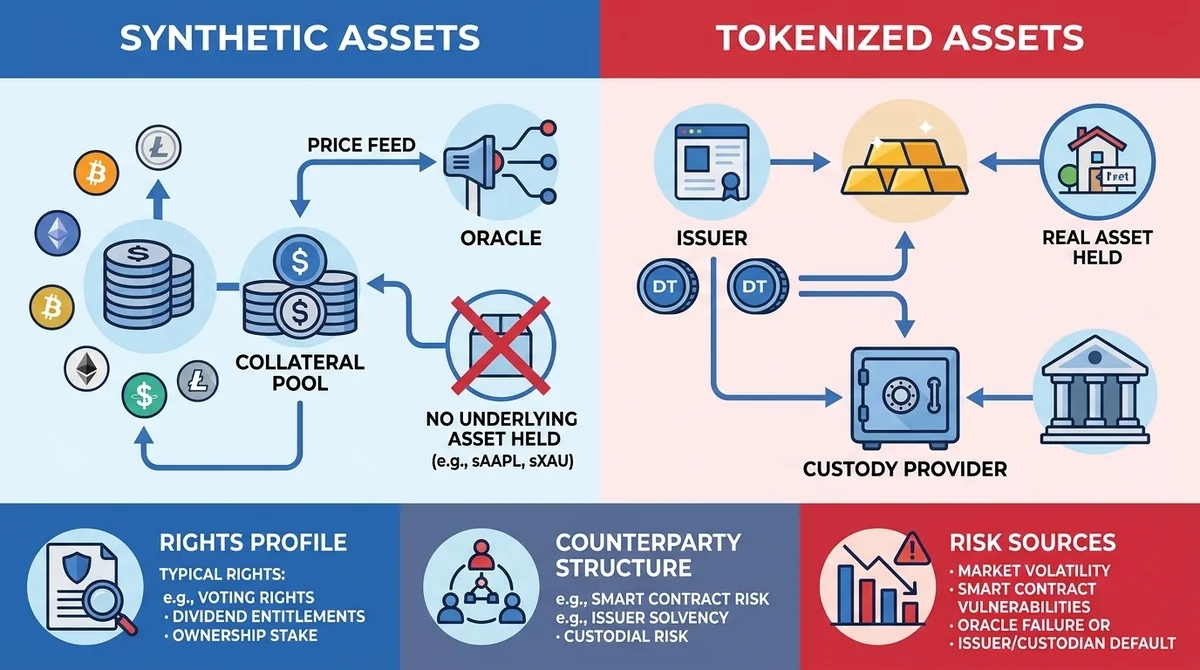
Synthetic assets carry counterparty, liquidation, and oracle failure risks; prices may deviate from the underlying, and losses can be amplified by the mechanism.
#How do counterparty and liquidation risks arise?
Synthetic asset solvency depends on the collateral pool and issuer structure; insufficient collateral or flawed mechanism design translates into counterparty risk. When the collateral ratio falls below the threshold, liquidation mechanics are triggered, and holders may be forced to reduce positions at unfavorable prices.
#What are the consequences of oracle failure?
Feed delays, data source anomalies, or single points of failure can cause contracts to execute liquidations or redemptions at prices that deviate from the market. Such deviations are more pronounced when volatility expands and often occur in concentrated bursts.
#Why can synthetic assets deviate from the underlying asset's price?
Synthetic asset prices can deviate from the underlying; the deviation itself is a mechanical friction cost, not an arbitrage signal. Sources of deviation include oracle update lag, insufficient collateral liquidity, restricted redemption channels, and the ongoing erosion of position costs by the funding rate; the magnitude of deviation often expands with market volatility.
#Who are synthetic assets for, and who should avoid them?
Synthetic assets suit users who understand derivative mechanics, need only price exposure, and can bear liquidation risk; users seeking genuine ownership or low risk should choose spot.
#When should you consider synthetic assets?
When your goal is to gain exposure to a particular underlying's price movements and you do not need underlying ownership attributes, synthetic assets structurally fit that need. You should also have a basic ability to judge collateral ratios, liquidation thresholds, and oracle mechanics.
#Which users should avoid synthetic assets?
Users seeking genuine ownership, shareholder rights, or low-volatility structures should not use synthetic assets. Those who lack understanding of liquidation mechanics, the funding rate, and oracle dependence should also avoid participating.
#How do you choose between synthetic assets and directly holding spot?
If you need only price exposure and can continuously monitor the collateral ratio and liquidation line, you may consider a synthetic asset structure. If you need genuine ownership and corporate-action rights, choose the spot or tokenized assets path. If you have limited risk tolerance and cannot bear loss of principal, avoid derivative-style tools. If you are oriented toward long-term holding, first calculate how the funding rate and rollover costs erode returns.
To further compare costs and use cases across tools, see the site's "multi-asset comparison and selection" topic, and check each item against your own needs before deciding.
#What disclaimers should you know before using synthetic assets?
Synthetic assets involve derivative-mechanism risks. This article is not investment advice; assess your own risk tolerance and understand that you may lose principal before use.
#Are synthetic assets suitable for long-term holding?
The structure of synthetic assets includes ongoing variables such as the funding rate and liquidation thresholds; long-term holding requires calculating costs and collateral adequacy period by period. Whether it suits long-term holding depends on mechanism parameters and your personal risk budget and cannot be generalized.
#What risk self-checks are needed before using synthetic assets?
- Verify collateral ratio requirements and liquidation trigger conditions
- Confirm oracle data sources and update frequency
- Calculate the combined cost of trading fees, how does perpetual futures funding rate work, and liquidation penalties
- Assess the liquidity and restrictions of redemption channels
- Clarify whether you accept price exposure rather than ownership attributes
- Set the maximum loss boundary you can bear
#FAQ
Q1: Can you receive dividends from synthetic assets? A: Usually not. Synthetic assets provide price exposure and generally carry no shareholder rights or corporate-action income tied to the underlying. Specific entitlement arrangements depend on product terms; anything not clearly disclosed should be treated as undisclosed data.
Q2: Is the synthetic asset price always equal to the underlying asset price? A: Not necessarily. Oracle delays, insufficient collateral liquidity, and redemption restrictions can all cause deviation, and the magnitude often expands with market volatility.
Q3: Can overcollateralization eliminate risk? A: It cannot eliminate risk, only mitigate it. In extreme markets, a decline in the collateral's own price can simultaneously lower the collateral ratio and trigger cascading liquidations.
Q4: Are synthetic assets and perpetual futures the same thing? A: Not exactly. Both are derivative-style instruments, but perpetual futures typically maintain their peg through the funding rate, while synthetic assets rely more on collateral and issuance/redemption mechanisms, so their risk source structures differ.
Q5: Can beginners use synthetic assets directly? A: It is not recommended to participate before understanding liquidation mechanics and oracle dependence. Build foundational knowledge first through spot and comparison content.
Q6: What is the difference between synthetic assets and spot? A: The core difference is the rights profile. Spot brings genuine ownership of the underlying; synthetic assets provide only price exposure, carry no shareholder rights or corporate-action income, and involve liquidation mechanics.
Q7: What are the risks of synthetic assets? A: Mainly counterparty and liquidation risk, oracle failure risk, and the risk of price deviation from the underlying; in extreme markets, depreciation of the collateral itself can trigger cascading liquidations, amplifying losses through the mechanism.
Q8: How do you choose between synthetic assets and tokenized assets? A: If you need rights attributes corresponding to real assets, choose tokenized assets news; only if you need price exposure and can bear liquidation and oracle risk should you consider synthetic assets. The two are not equivalent.
To compare the rights profile, costs, and liquidation mechanics of different tools item by item against your own needs, see the site's "multi-asset comparison and selection" topic; commercial links will be labeled "Commercial link · does not affect ratings or rankings."
This content is compiled from public information and general mechanism knowledge and does not constitute investment or open account advice. No specific fee rates, platform parameters, or on-chain figures are cited; mechanism descriptions are qualitative, and details should defer to each platform's official disclosures. Data as of 2026-08-21 and subject to change.
FAQ
Can you receive dividends from synthetic assets?
Usually not. Synthetic assets provide price exposure and generally carry no shareholder rights or corporate-action income tied to the underlying. Specific entitlement arrangements depend on product terms; anything not clearly disclosed should be treated as undisclosed data.
Is the synthetic asset price always equal to the underlying asset price?
Not necessarily. Oracle delays, insufficient collateral liquidity, and redemption restrictions can all cause deviation, and the magnitude often expands with market volatility.
Can overcollateralization eliminate risk?
It cannot eliminate risk, only mitigate it. In extreme markets, a decline in the collateral's own price can simultaneously lower the collateral ratio and trigger cascading liquidations.
Are synthetic assets and perpetual futures the same thing?
Not exactly. Both are derivative-style instruments, but perpetual futures typically maintain their peg through the funding rate, while synthetic assets rely more on collateral and issuance/redemption mechanisms, so their risk source structures differ.
Can beginners use synthetic assets directly?
It is not recommended to participate before understanding liquidation mechanics and oracle dependence. Build foundational knowledge first through spot and comparison content.
Related Terms
Read the review? Ready to try a small position?
The crypto assets and tokenized US stocks/ETFs covered here are available on MSX — spot and perpetuals.
Quick Start Trading →New here? Registration takes three quick steps.