US Treasury Bonds
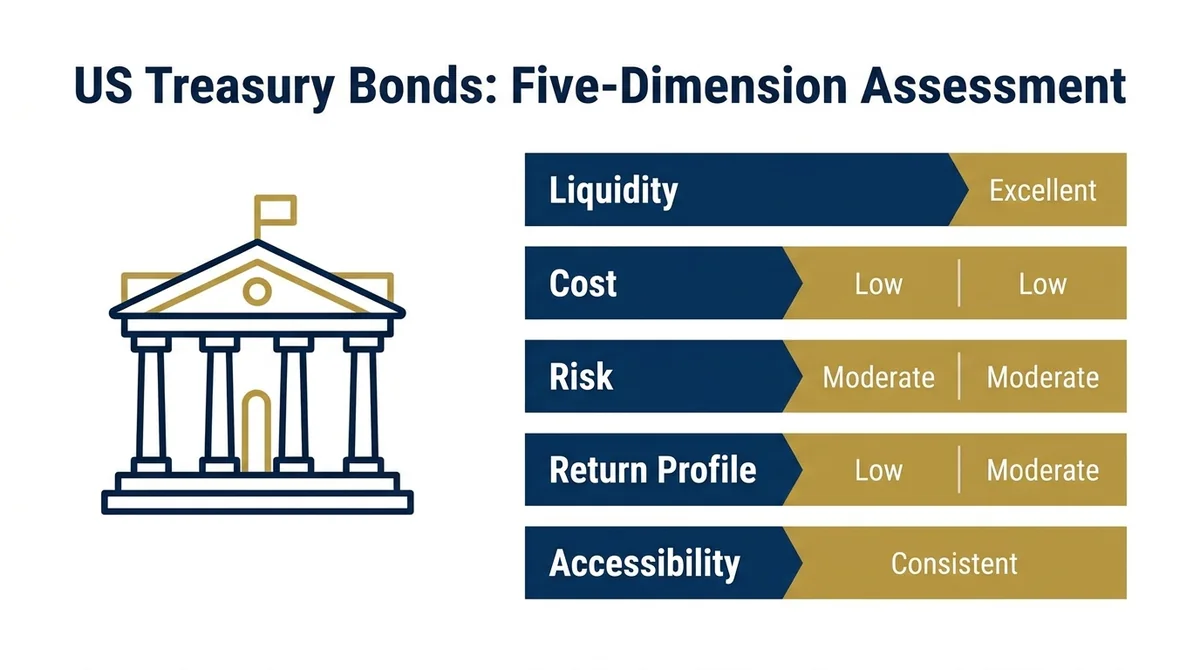
US Treasury bonds review: qualitative ratings across credit risk, rate and duration risk, liquidity, coupon structure and portfolio role, plus pros, cons and who they suit.
Conclusion: US Treasury bonds suit allocation-oriented capital that needs USD exposure and values relative principal stability; they do not suit capital targeting short-term price spreads or high-volatility returns. This article gives a qualitative assessment across five dimensions and does not provide an unverified quantitative total score.
Data cutoff date: 2025-06-30. Specific figures such as coupons and maturities mentioned in this article have not been publicly verified and should be based on official issuance information from the U.S. Department of the Treasury.
Five-dimension rating overview
| Dimension | Qualitative rating | One-line conclusion |
|---|---|---|
| Liquidity | Relatively high | Deep market; mainstream maturities trade actively |
| Cost | Relatively low | Clear coupon structure; holding cost is mainly opportunity cost and bid-ask spread |
| Risk | Medium-low | Low credit risk; interest rate and duration risk rise as duration lengthens |
| Return profile | Medium | Predictable cash flows; return ceiling constrained by coupon |
| Accessibility | Relatively high | Mature access paths within the USD account system |
#What are US Treasury bonds, and what role do they play in a portfolio?
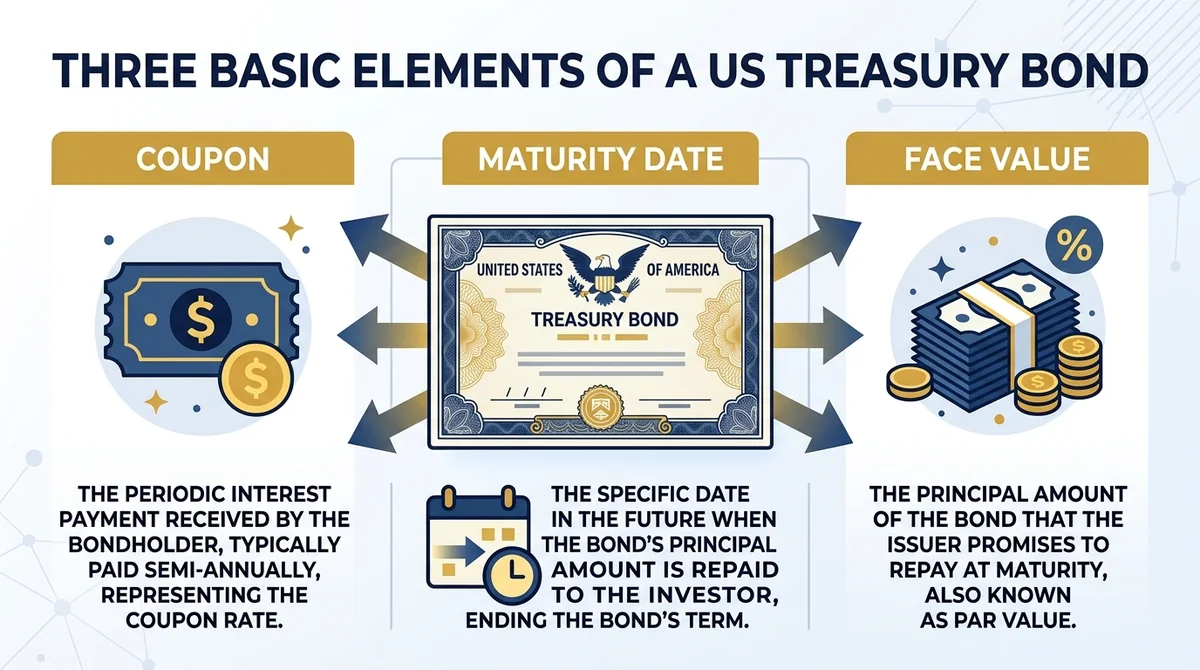
US Treasury bonds are debt instruments issued by the U.S. federal government. Investors buy at face value, receive periodic cash flows from the coupon, and get principal back at maturity. The issuer is the U.S. federal government, so credit risk is relatively low; coupon, maturity date and face value form their basic structure.
In a portfolio, tokenized treasury bonds usually play a stabilizer role and provide direct USD asset exposure, rather than acting as an aggressive position chasing high volatility.
#Who issues US Treasuries, and how does repayment work?
Repayment of US Treasuries comes from the fiscal capacity and credit of the U.S. federal government, not from a single company's cash flow, so the credit risk dimension is relatively strong among the five dimensions. But that does not mean prices do not fluctuate.
#How should the three basic elements of coupon, maturity and face value be understood?
The coupon determines the cash flow level during the holding period, the maturity date determines duration and interest rate sensitivity, and the face value determines the repayment amount at maturity. Together these three determine the holding experience of a bond. Specific coupon and maturity data are not public and should be based on official issuance information from the U.S. Department of the Treasury.
#Do they usually play an offensive or defensive role in a portfolio?
They lean defensive and stabilizer. When risk assets see amplified volatility, the predictability of Treasury cash flows provides a buffer; but this does not mean they necessarily move inversely to stock prices—historically, there have also been periods when both fell together.
#How should the five evaluation dimensions of US Treasury bonds be viewed?
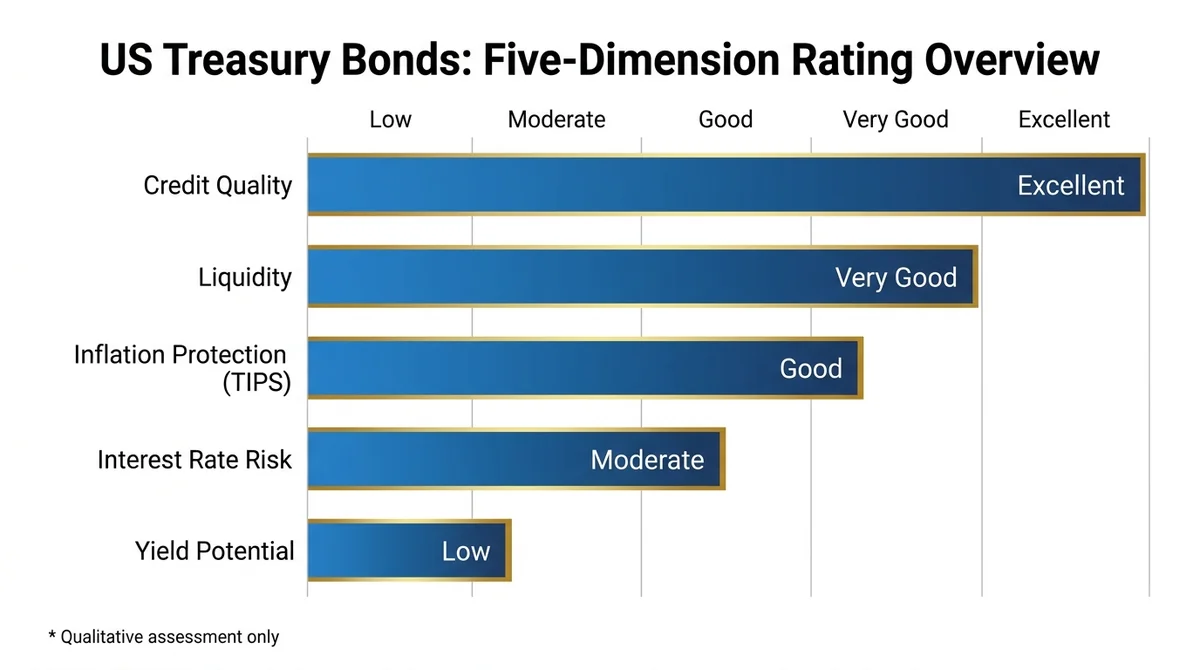
| Dimension | Qualitative rating | Explanation |
|---|---|---|
| Liquidity | Relatively high | Deep market; mainstream maturities trade actively |
| Cost | Relatively low | Clear coupon structure; holding cost is mainly opportunity cost and bid-ask spread |
| Risk | Medium-low | Low credit risk, but interest rate and duration risk rise as duration lengthens |
| Return profile | Medium | Predictable cash flows; return ceiling constrained by coupon |
| Accessibility | Relatively high | Mature access paths within the USD account system |
#Why does the credit risk dimension stand out?
The credit risk dimension of US Treasuries is the strongest of the five: the issuer is the U.S. federal government, and compared with domestic-currency corporate bonds and credit bonds, default-related credit risk is significantly lower.
#How do interest rate sensitivity and duration risk affect the assessment?
The longer the duration, the greater the impact of interest rate changes on price. Long-duration instruments come under more obvious price pressure during rate hike cycles, so duration risk rises as duration lengthens and the assessment declines accordingly.
#What weight do liquidity and coupon structure each carry?
This article does not give specific weight numbers. What is certain: from an allocation perspective, liquidity and coupon structure should carry more weight than from a trading perspective, and the risk dimension (especially interest rate risk) should serve as the main constraint. The weighting reflects an allocation perspective, not a trading perspective.
#What are the pros and cons of US Treasury bonds?
#Where are the main advantages concentrated?
The main advantages of US Treasuries are concentrated in three areas: relatively low credit risk, deep market, and predictable cash flows. They are better suited to medium- and long-term capital aimed at allocation rather than trading.
- Relatively low credit risk: The issuer is the U.S. federal government, and the credit dimension is the strongest of the five.
- Deep market: Mainstream maturities trade actively, with high capacity to absorb entries and exits.
- Predictable cash flows: Coupon and maturity repayment structures are clear, making cash flow planning easier.
#What are the main shortcomings and risk points?
The main shortcomings of US Treasuries are price pressure when rates rise, notable volatility in long-duration instruments, and uncertain reinvestment returns—all three affect the actual holding experience.
- Price pressure when rates rise: Bond prices move inversely to market rates, and the holding experience deteriorates markedly during rate hike cycles.
- Notable volatility in long-duration instruments: The longer the maturity, the more sensitive the price to rate changes, and short-term mark-to-market swings may exceed what allocation-oriented capital expects.
- Reinvestment risk: Market rates at which coupons and maturing principal are reinvested are uncertain, affecting long-term actual returns.
#Which risks are structural risks that cannot be ignored?
Interest rate risk and reinvestment risk are structural risks that cannot be eliminated by diversifying across a single maturity, and can only be partially mitigated through duration management.
#Who should consider US Treasury bonds, and who should not?
US Treasuries suit allocation-oriented capital that needs USD exposure and values principal stability. They do not suit trading-oriented capital seeking short-term spreads or high-volatility returns, nor non-USD users unable to bear currency translation risk.
#Who they suit
- Capital that needs USD asset exposure for the purpose of asset allocation
- Investors who value relative principal stability and can accept a lower return ceiling
- Capital that needs predictable cash flows to match future expenditures
#Who they do not suit
- Trading-oriented capital seeking short-term spread gains
- Capital targeting high volatility and high returns
- Non-USD users unable to bear currency translation fluctuations (who must assess FX factors themselves)
#When allocating, should you focus on maturity or coupon?
Maturity first. Maturity determines interest rate sensitivity and the magnitude of price volatility, and is the dominant variable in the holding experience; the absolute coupon level mainly affects cash flow and should not be the sole basis for decisions.
#What risks and limitations should be understood before allocating to US Treasury bonds?
#How do interest rate changes affect the holding experience?
When rates rise, the price of existing bonds falls; selling midway may realize a loss, while investors holding to maturity mainly bear opportunity cost.
#What does the exchange rate factor mean for non-USD users?
For investors whose base currency is not USD, actual returns are affected by currency translation, and the USD return on Treasuries may diverge from the return in their local currency.
#How should decisions be made when data disclosure is missing?
Specific data such as coupons and maturities mentioned in this article are not public and should be based on official issuance information from the U.S. Department of the Treasury; decisions should not rely on second-hand summaries. You can check issuance announcements through official U.S. Treasury debt and issuance channels (such as TreasuryDirect).
#FAQ
Q1: Are US Treasury bonds zero-risk assets? No. Credit risk on US Treasuries is relatively low, but they are not zero-risk: interest rate risk, reinvestment risk and currency translation risk remain, prices move with market rates, and selling midway may realize a loss.
Q2: What proportion of a portfolio do US Treasuries usually take? There is no universal ratio; it depends on risk budget and USD exposure needs. This article does not give specific allocation numbers; it is advisable to first determine tolerable volatility, then decide duration.
Q3: How should long-duration and short-duration US Treasuries be chosen? It depends on the goal: if the aim is a stabilizer, short- and medium-term maturities have smaller price volatility and are better for controlling mark-to-market drawdowns; if you can tolerate mark-to-market volatility and want to lock in longer-duration cash flows, long-duration instruments may be considered.
Q4: What should non-USD users note when allocating to US Treasuries? Both interest rate risk and exchange rate risk need to be assessed; the two may stack in the same direction, and local-currency returns may diverge from USD returns.
Q5: Where can US Treasury coupon and maturity data be verified? It should be based on disclosures from official issuance channels such as the U.S. Department of the Treasury. Specific coupon and maturity data mentioned in this article are not public and no figures are provided.
This content is compiled from public information and does not constitute investment or open account advice. Specific data such as coupons and maturities in this article have not been publicly verified; actual information should be based on official issuance information from the U.S. Department of the Treasury.
Commercial link · Does not affect ratings or rankings: to compare the holding experience of different maturities, see the site's bond category comparison page.
FAQ
Are US Treasury bonds zero-risk assets?
No. Credit risk is relatively low, but interest rate risk, reinvestment risk and currency translation risk remain, and prices move with market rates.
What proportion of a portfolio do US Treasuries usually take?
There is no universal ratio; it depends on risk budget and USD exposure needs. This article does not give specific allocation numbers; it is advisable to first determine tolerable volatility, then decide duration.
How should long-duration and short-duration US Treasuries be chosen?
If the aim is a stabilizer, short- and medium-term maturities have smaller price volatility; if you can tolerate mark-to-market volatility and want to lock in longer-duration cash flows, long-duration instruments may be considered.
What should non-USD users note when allocating to US Treasuries?
Both interest rate risk and exchange rate risk need to be assessed; the two may stack in the same direction, and local-currency returns may diverge from USD returns.
Where can US Treasury coupon and maturity data be verified?
It should be based on disclosures from official issuance channels such as the U.S. Department of the Treasury. Specific coupon and maturity data mentioned in this article are not public and no figures are provided.
Related Terms
Read the review? Ready to try a small position?
The crypto assets and tokenized US stocks/ETFs covered here are available on MSX — spot and perpetuals.
Quick Start Trading →New here? Registration takes three quick steps.