Intel vs TSMC Comparison Extended: Three-Way Contrast of 2026 Foundry Customer Structure and Capacity Allocation (Samsung and AMD Enter the Picture)
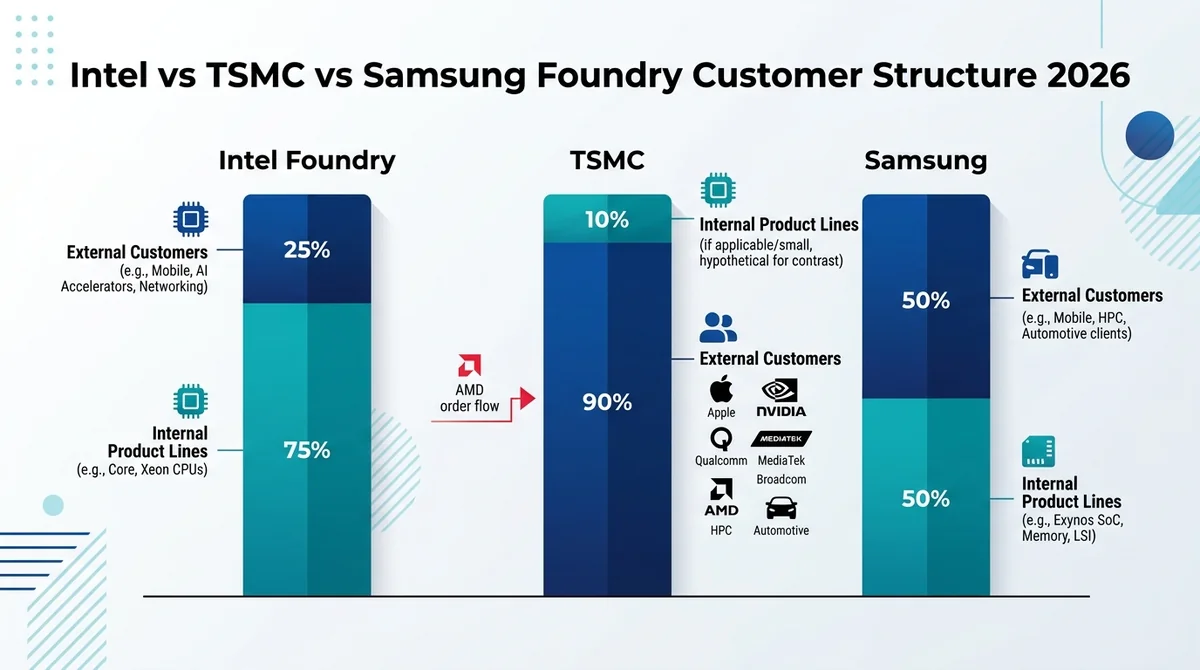
A side-by-side look at Intel and TSMC through customer structure and capacity allocation, with Samsung and AMD as third-party variables shaping the three-way foundry landscape.
Conclusion: If customer structure diversity is the primary criterion, TSMC's external customer base is more diversified; if internal synergy and capacity priority are the criteria, Intel's foundry capacity is more oriented toward serving its own product lines. Samsung provides a third-pole multi-source option, and AMD's order flow is a key observational signal for distinguishing the two companies' customer structures. These judgments form a structural observation framework, not conclusions about specific market share or pricing.
#What is the difference between Intel's and TSMC's foundry customer structures?
Intel Foundry's customer structure relies more on its own product lines and a small number of external orders, while TSMC is dominated by diversified external large customers. AMD's order flow is a key signal for distinguishing the two customer structures.
#Which external major players make up TSMC's customers?
Since its founding, TSMC's foundry model has been centered on external customers, with a customer portfolio spanning high-performance computing, mobile SoCs, networking, and consumer electronics, among other downstream segments. Its customer list and each customer's revenue share are disclosed in public financial reports, but some detailed data, such as the latest share of any single customer and process node allocation, is not public.
Structurally, TSMC's customer concentration is usually described as "a few mega-customers plus a long tail," which means its capacity planning requires queuing and allocation among multiple customers rather than revolving around a single product line.
#Why does Intel Foundry rely more on internal and a small number of external orders?
Intel's foundry business grew out of its own IDM system, and its wafer capacity historically served its own CPUs and related product lines first. Opening foundry services to external customers is a relatively new business direction, so the share of external orders is relatively limited, and the specific external customer list and order scale data are not public.
This structure creates two differences: first, capacity priority has a stronger internal character; second, when evaluating Intel Foundry, external customers need to additionally consider where their orders rank behind internal product lines.
#How does AMD's position differ in the two customer structures?
AMD is one of TSMC's long-term external large customers, and its CPU and GPU product lines have long relied on external advanced-node foundry services, so it falls into the "external large customer" category in TSMC's customer structure.
For Intel, AMD is both a direct competitor in the product market and a reference for potential external customers in the foundry business. AMD's order flow therefore becomes a signal for observing the difference in the two customer structures: if AMD-like external large customers continue to concentrate at TSMC, it suggests that Intel Foundry's external customer expansion is still at an early stage. Specific order allocation and contract details are not public.
#How do the two companies' capacity allocation logics differ in 2026?
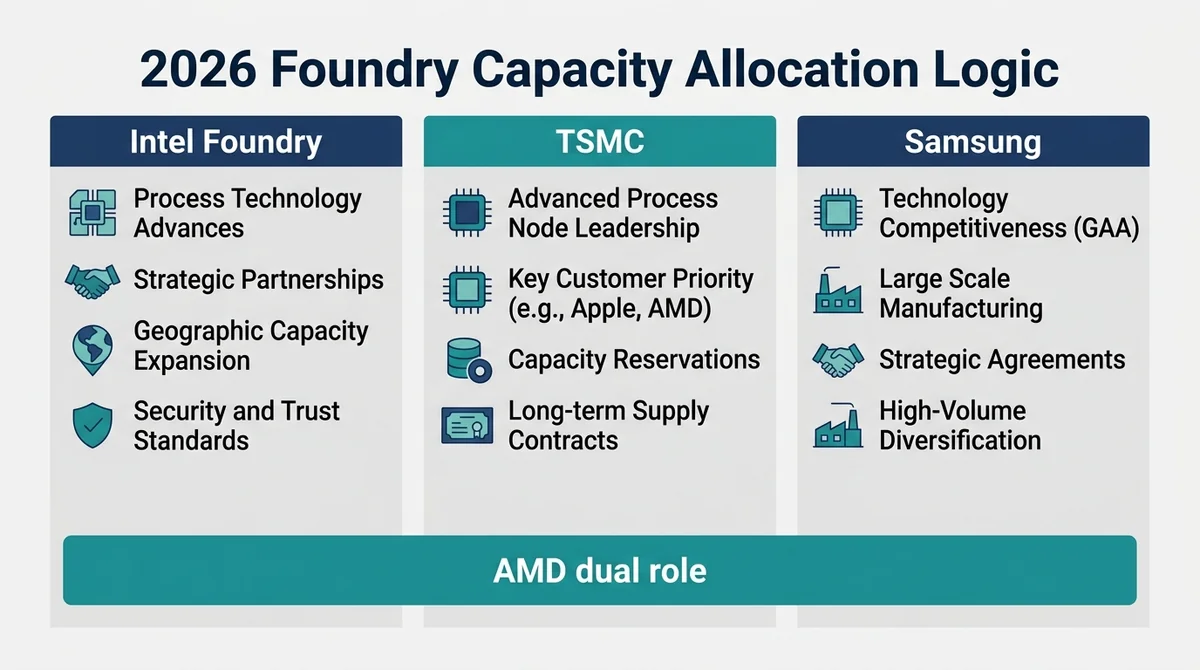
TSMC tends to spread advanced-node capacity across multiple customers, while Intel Foundry prioritizes its own product lines. This difference in allocation logic directly affects external customers' queuing and bargaining.
#How does TSMC allocate advanced-node capacity among different customers?
TSMC's capacity allocation is based on customer orders and long-term agreements, and typically shows multi-customer sharing at advanced process nodes. Customers need to lock in their position through capacity reservations, prepayments, and similar means; specific allocation ratios and prepayment terms are not public.
As a result of this mechanism, external customers obtain a "queue position" at TSMC rather than a default priority; bargaining power is related to order scale and cooperation history.
#Whom does Intel Foundry capacity serve first?
Intel Foundry capacity serves its own product lines first, an allocation logic inherited from the IDM system. External customers' availability during capacity-tight periods depends on the production scheduling rhythm of internal product lines; specific scheduling details are not public.
For external customers focused on capacity availability, this means they need to evaluate not only process parameters but also how internal orders occupy capacity.
#How does the capacity allocation difference affect customer choices?
Under the multi-customer sharing model, customers obtain a relatively predictable queuing mechanism, but wait times may lengthen when advanced-node capacity is tight. Under the internal-priority model, customers may gain closer collaboration, but capacity availability uncertainty stems from internal scheduling.
Neither model is absolutely superior; it depends on the customer's own weighting of delivery certainty versus collaboration depth.
#How does Samsung's entry change the three-way foundry landscape?
As a third pole, Samsung's foundry exposure provides customers with a multi-source option beyond TSMC and Intel. In a three-way landscape, customers are more inclined to split by process and capacity availability. This judgment is an inference based on business structure, and there is no public data to directly verify customers' actual split ratios.
#Where is Samsung Foundry's customer exposure?
Samsung's foundry business is also primarily oriented toward external customers while serving its own memory and end-product lines, forming a structure where internal and external run in parallel. Its external customer list and node-by-node capacity allocation data are not public.
#What differentiates Samsung from Intel and TSMC?
The three differ mainly in customer structure (pure external vs. internal-external parallel vs. internal priority) and capacity allocation logic (multi-customer sharing vs. internal-external parallel vs. internal priority). Samsung's position sits between the other two: it has external customers as the main body while retaining capacity occupation by internal product lines.
#How will customers choose in a three-way landscape?
Driven by multi-source procurement motives, customers tend to split by process availability, capacity queue position, and collaboration depth rather than locking into a single supplier. The final choice of any specific customer is a business decision, and the data is not public.
#Intel vs TSMC key dimension comparison table
Use a comparison table focused on customer structure and capacity allocation to contrast Intel and TSMC, with Samsung and AMD listed separately as third-party variables, and mark missing items as data not public.
| Dimension | TSMC | Intel Foundry | Data status |
|---|---|---|---|
| Main body of customer structure | Primarily external customers | Primarily internal product lines, external secondary | Qualitative, business model publicly verifiable |
| Customer concentration | A few mega-customers + long tail | Highly concentrated internally | Specific share data not public |
| External order share | Dominant position | Relatively limited | Specific figures not public |
| Advanced-node capacity allocation mechanism | Multi-customer sharing | Internal priority | Qualitative |
| How customers lock in capacity | Capacity reservations, prepayments, etc. | Depends on internal scheduling rhythm | Terms details not public |
| Queuing rules when capacity is tight | Queue by orders and agreements | Internal scheduling priority | Details not public |
| Third-party variable: Samsung | External customers + internal parallel | Same as left | Customer list not public |
| Third-party variable: AMD | Long-term external large customer | Competitor and potential customer reference | Order allocation not public |
#How to compare the customer structure dimension?
Look at the magnitude of external customer share, customer concentration, and customer type distribution. TSMC is dominated by diversified external large customers, while Intel is dominated by internal product lines with external orders secondary.
#How to compare the capacity allocation dimension?
Look at the advanced-node capacity allocation mechanism (multi-customer sharing vs. internal priority), how customers lock in capacity, and the queuing rules when capacity is tight.
#How to incorporate the Samsung and AMD variables into the comparison?
Samsung, as the third pole, is included through two dimensions: customer exposure and differentiated positioning; AMD, as an external large-customer reference, is included through the order flow dimension. Neither is treated as an independent comparison object, only as a reference variable.
#Which side should different focuses look at?
If customer diversity is the focus, look at TSMC first; if internal synergy and capacity are the focus, look at Intel; if multi-source options are the focus, incorporate the Samsung and AMD variables into the comparison.
#Who to look at for customer diversity?
If you are an observer assessing the dispersion of foundry customer structure, prioritize TSMC's external large-customer portfolio and concentration metrics.
#Who to look at for capacity availability?
If you focus on the certainty of external orders' queue position when capacity is tight, prioritize TSMC's multi-customer sharing mechanism; if you focus on collaboration depth with internal product lines, prioritize Intel's internal-priority logic.
#Who to look at for third-party variables?
If you want to assess the possibility of multi-source procurement, include Samsung's foundry exposure and AMD's order flow in your observation.
#Risks and information boundaries in the comparison
This comparison is based only on disclosed metrics; much of the customer and capacity detail is not public, and no price forecasts or investment advice are provided. It is for decision reference only.
#Which data fall under non-public metrics?
Single-customer revenue share, customer allocation ratios at specific process nodes, capacity reservation terms, and external customer contract details all fall within the scope of non-public data. This comparison does not provide estimates for these items.
#Why no price or share forecasts?
Customer structure and capacity allocation are structural observation dimensions, and their changes are affected by business negotiations and scheduling rhythms, lacking a verifiable public forecasting basis. This comparison only describes disclosed structural differences and does not derive price targets or market share figures.
To verify the original disclosure metrics, see each company's official investor relations pages and financial report originals.
This content is compiled from public data and does not constitute investment or open account advice. This article does not mark a specific data cutoff date because no specific figures are cited; actual conditions may change.
FAQ
What is the share of external customers in Intel Foundry?
The specific external customer share and customer list fall within the scope of non-public data, and this comparison does not estimate them. The publicly verifiable metric is that Intel Foundry grew out of the IDM system, its capacity historically served its own product lines first, and opening to external customers is a relatively new direction.
How should TSMC's customer concentration be understood?
TSMC is primarily oriented toward external customers, and its structure is usually described as a few mega-customers plus a relatively long tail. The latest revenue share of any single customer and process allocation details are not public and should be based on financial report disclosure metrics.
Why is AMD's order flow an observational signal?
AMD has long relied on external advanced-node foundry services, falls into the category of TSMC's external large customers, and is also a direct competitor to Intel in the product market. Where its orders concentrate can serve as a reference for judging the stage of Intel Foundry's external expansion, but it is not sufficient on its own to prove success or failure of that expansion.
What is Samsung's position in the three-way landscape?
Samsung sits between TSMC and Intel: it has external customers as the main body while retaining capacity occupation by internal product lines. Its external customer list and node capacity allocation data are not public.
Does this comparison recommend which side to buy?
No. This article only contrasts the two structural dimensions of customer structure and capacity allocation, does not make price forecasts or share forecasts, and does not constitute investment advice.
Related Terms
Done comparing? Ready to place your first trade?
The crypto assets, tokenized US stocks and ETFs you just compared are all tradable on MSX — spot or perpetuals.
Quick Start Trading →New here? Registration takes three quick steps.