Semiconductor Stocks vs Memory Chip Stocks: Comparing Return Drivers and Cyclical Risk of AI Compute and Memory Exposure in 2026
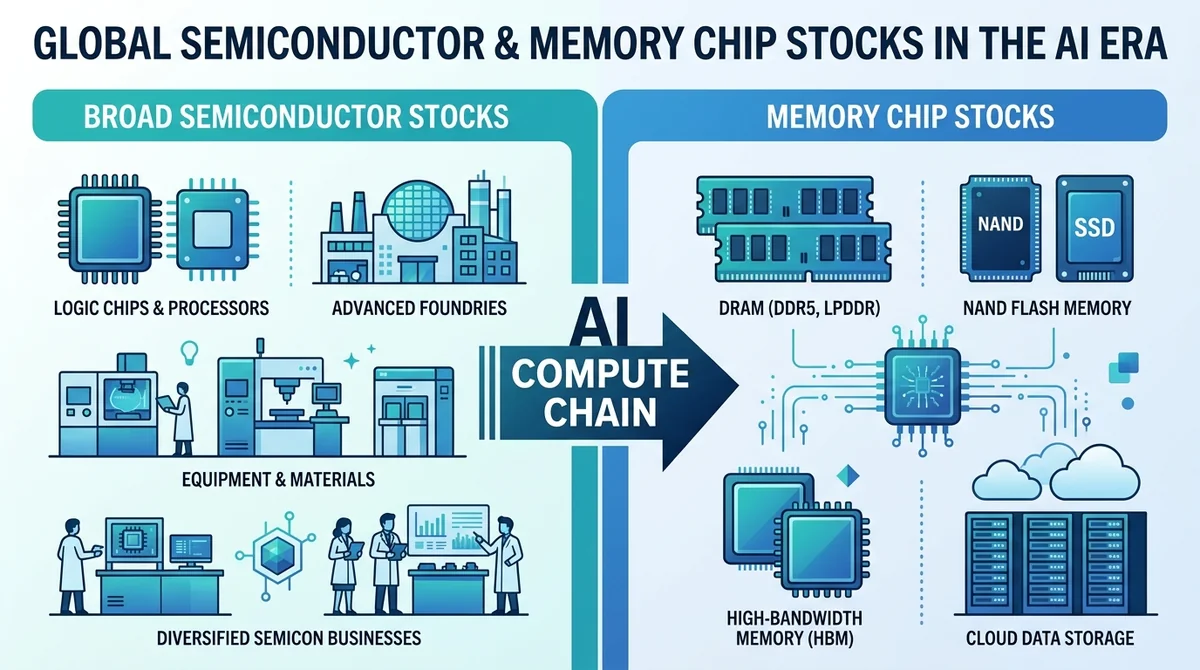
Semiconductor and memory chip stocks differ in return drivers, cyclical risk, and AI compute exposure. This comparison covers business scope, HBM demand pass-through, and cyclical swings.
Conclusion: If the goal is to diversify AI compute exposure, look first at broad semiconductor stocks covering logic chips, foundry, and equipment; only look at memory chip stocks separately if the goal is to bet on memory supply-demand elasticity and you can tolerate stronger cyclical swings. When combining the two, watch for overlapping exposure in the HBM segment.
Data status note: This article is a structural comparison and does not cite specific companies' financial figures, market caps, or price changes. Any specific numbers should be based on each company's latest public disclosures (such as 10-K/20-F filings and earnings calls). This article does not provide unverified numbers.
#What exactly is the difference between semiconductor stocks and memory chip stocks?
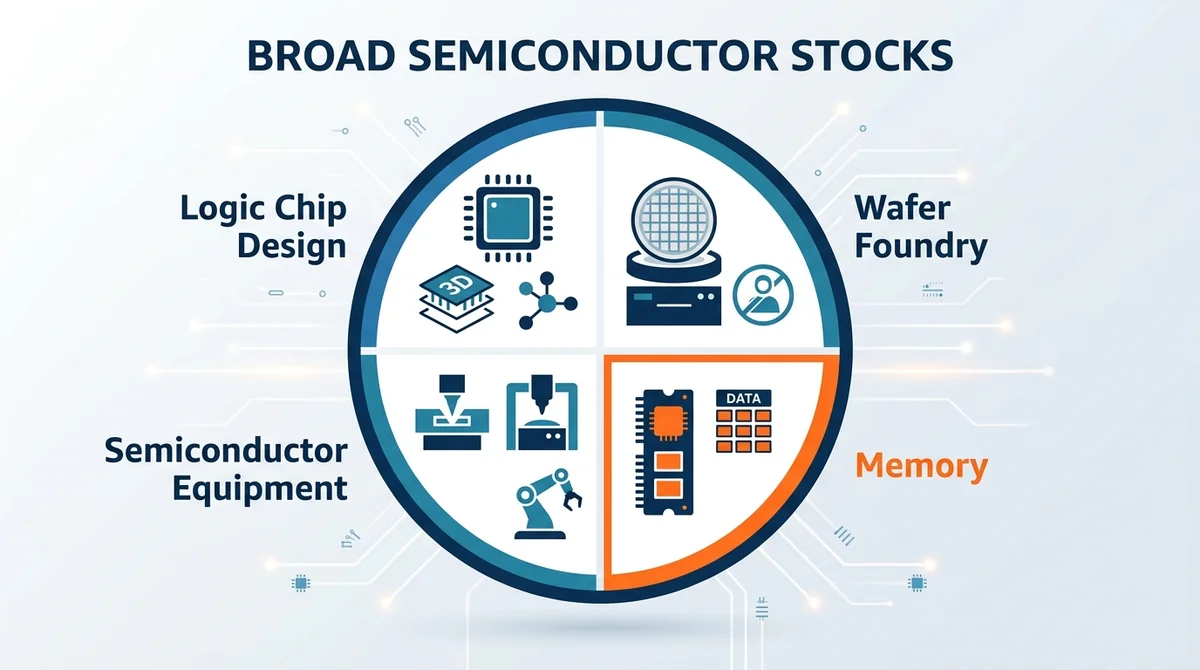
How is the business scope of each divided? Broad semiconductors cover logic chip design, wafer foundry, semiconductor equipment, and memory, among other segments. Memory chip stocks are a subsegment within that, with revenue more concentrated on DRAM and NAND prices and shipment volumes.
What do AI compute exposure and memory exposure each refer to? AI compute exposure refers to the portion of revenue coming from compute chip shipments, foundry capacity utilization, and equipment capital expenditure. Memory exposure refers to the portion of revenue coming from HBM and memory capacity. The two sit at different positions along the same compute chain.
Why are memory chip stocks often looked at separately? Because memory is a standardized product, its price is directly determined by the supply-demand gap, and earnings volatility is more concentrated than broad semiconductor stocks that cover multiple segments, so it is often analyzed as an independent cyclical category.
#How do the return drivers of the two differ?
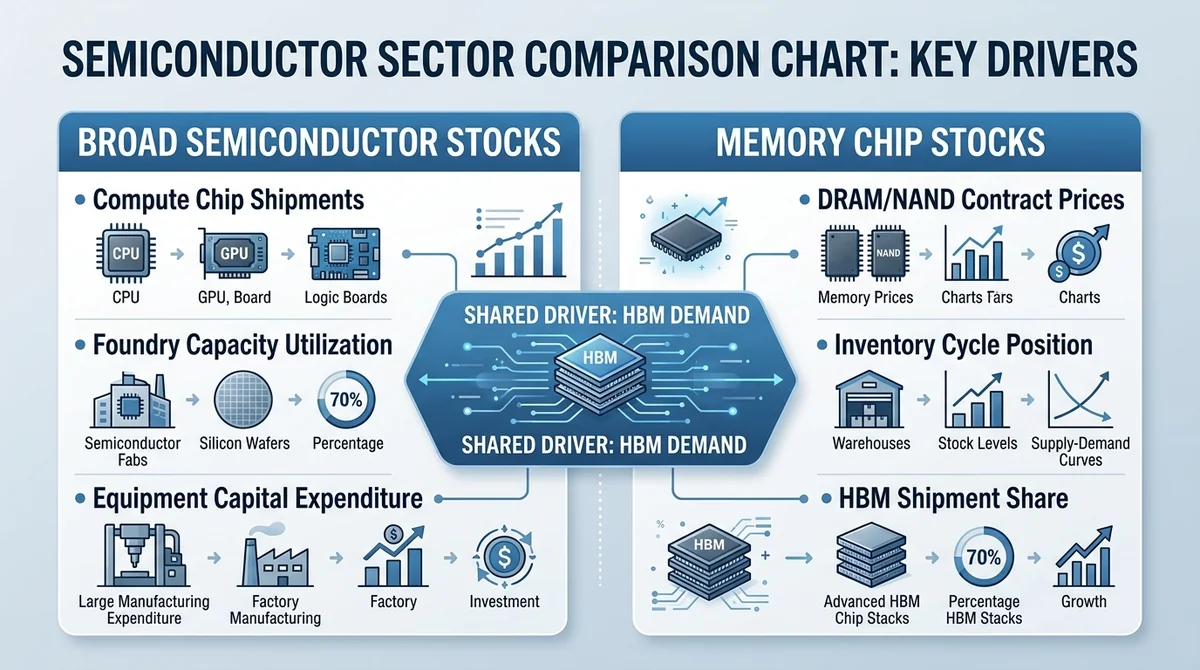
Where do semiconductor stocks mainly get their returns? Compute chip shipment volumes, foundry capacity utilization, and the pace of capital expenditure on the equipment side are the main revenue variables for broad semiconductor stocks.
Where do memory chip stocks mainly get their returns? DRAM/NAND contract prices, inventory cycle position, and the share of HBM shipments are the main revenue variables for memory chip stocks.
How does HBM demand affect both at the same time? HBM demand is both a result of compute expansion and a consumer of memory capacity. It links compute chips and memory chips on the same chain, so the two are not entirely independent lines.
#Why is the cyclical risk of memory chip stocks more concentrated?
How does the memory cycle form? Memory is a standardized product, and price is determined by the supply-demand gap. When supply growth outpaces demand growth, falling prices directly compress earnings.
Why does supply expansion easily push prices down? Capacity expansion lags, which easily creates oversupply when demand weakens, thereby amplifying the magnitude of price declines.
Where is the volatility difference between memory chip stocks and semiconductor stocks? Earnings volatility for memory chip stocks is usually more concentrated than for broad semiconductor stocks, because the latter cover multiple segments, so the impact of a single price variable is partly diversified.
#Will AI compute expansion change the cycle of memory chip stocks?
Does HBM demand weaken the traditional memory cycle? HBM consumes more capacity, which may change the supply rhythm of traditional DRAM, but the extent of this effect depends on capacity allocation and demand sustainability, and public data has no unified conclusion yet.
What is the relationship between compute capital expenditure and memory demand? The market generally treats compute capital expenditure as a leading variable for HBM demand (speculative). Changes in the pace of capital expenditure pass first to HBM orders, then to memory capacity arrangements.
If AI compute slows, which is more sensitive? A common judgment is that memory chip stocks may be more sensitive due to capacity rigidity, because capacity adjustments take time while prices react first; but this judgment has no unified empirical conclusion yet and needs verification with specific companies' capacity and inventory data.
#Who is suited to looking at semiconductor stocks, and who is suited to looking at memory chip stocks?
How should you choose if you want to diversify compute exposure? Semiconductor stocks covering multiple segments are better suited to diversifying compute exposure, because revenue sources are not concentrated on a single price variable.
How should you choose if you want to bet on memory supply-demand elasticity? Only users who can tolerate cyclical swings are suited to looking at memory chip stocks separately, because their earnings elasticity is large while downside volatility is also greater.
Can the two be allocated at the same time? They can be combined, but watch for overlapping exposure in the HBM segment to avoid repeated exposure at the same position on the compute chain.
#Scenario breakdown
- If you are a user hoping to diversify AI compute exposure: Focus on broad semiconductor stocks covering logic chips, foundry, and equipment, with memory as a satellite allocation.
- If you are a user hoping to bet on memory supply-demand elasticity: Track DRAM/NAND contract prices and the share of HBM shipments separately, and accept greater cyclical swings.
- If you are a user allocating to both at the same time: Clarify the overlapping exposure in the HBM segment to avoid the same risk factor being priced twice.
- If you are a user focused on the pace of compute capital expenditure: Treat capital expenditure as a leading variable for HBM demand to observe (a speculative framework), looking at spending first and memory second.
#Action checklist
- Clarify whether you want compute exposure or memory exposure; they are not the same thing.
- Check the share of DRAM/NAND and HBM in the target's revenue composition; if the data is not public, mark it as not public.
- Track DRAM/NAND contract prices and inventory cycle position.
- Track the pace of compute capital expenditure as a leading variable for HBM demand.
- Check whether the portfolio has duplicate exposure in the HBM segment.
- Assess your own tolerance for cyclical swings.
#FAQ
Are semiconductor stocks and memory chip stocks the same type of asset? No. Memory chip stocks are a subsegment of the semiconductor sector, with revenue more concentrated on memory prices and HBM demand.
Will HBM demand weaken the traditional memory cycle? It may change the supply rhythm, but the extent of the effect depends on capacity allocation and demand sustainability, and public data has no unified conclusion yet.
Who is more sensitive when AI compute slows? A common judgment is that memory chip stocks may be more sensitive due to capacity rigidity, with prices reacting first; this judgment has no unified empirical support yet and needs verification with specific company data.
Can the two be allocated at the same time? Yes, but watch for overlapping exposure in the HBM segment to avoid the same risk factor being priced twice.
Does this article recommend specific targets? No. This article only compares exposure and cyclical characteristics and does not predict prices.
This content is compiled from public information and does not constitute investment or open account advice. It does not cite specific companies' financial figures; any numbers should be based on each company's latest public disclosures.
FAQ
Are semiconductor stocks and memory chip stocks the same type of asset?
No. Memory chip stocks are a subsegment of the semiconductor sector, with revenue more concentrated on memory prices and HBM demand.
Will HBM demand weaken the traditional memory cycle?
It may change the supply rhythm, but the extent of the effect depends on capacity allocation and demand sustainability, and public data has no unified conclusion yet.
Who is more sensitive when AI compute slows?
A common judgment is that memory chip stocks may be more sensitive due to capacity rigidity, with prices reacting first; this judgment has no unified empirical support yet and needs verification with specific company data.
Can the two be allocated at the same time?
Yes, but watch for overlapping exposure in the HBM segment to avoid the same risk factor being priced twice.
Does this article recommend specific targets?
No. This article only compares exposure and cyclical characteristics and does not predict prices.
Related Terms
Done comparing? Ready to place your first trade?
The crypto assets, tokenized US stocks and ETFs you just compared are all tradable on MSX — spot or perpetuals.
Quick Start Trading →New here? Registration takes three quick steps.